Weathering Steel (Corten Steel): Properties, Uses & Advantages
Weathering steel — popularly known by the trademark name Corten — is a group of steel alloys developed to eliminate the need for painting by forming a stable, protective rust-like patina when exposed to the atmosphere. Combining structural performance with aesthetic appeal, weathering steel has found a unique position in both industrial and architectural applications.
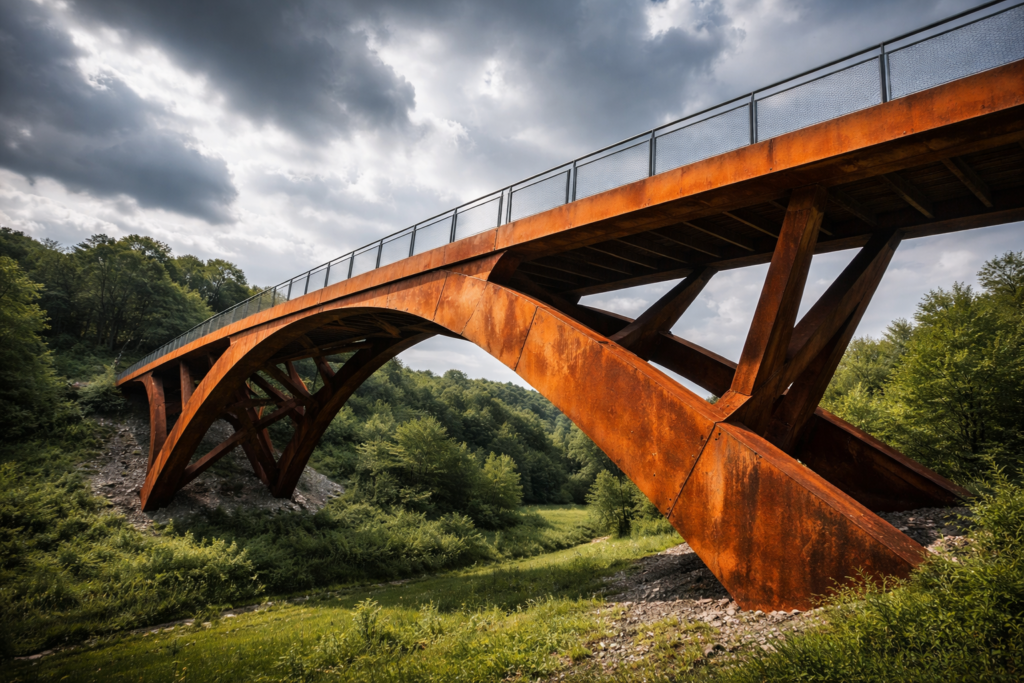
- What Is Weathering Steel?
Weathering steel is a high-strength, low-alloy (HSLA) steel that contains small additions of copper, chromium, nickel, and phosphorus. These alloying elements cause the steel to form a tightly adherent, protective oxide layer (patina) when cyclically wetted and dried. Unlike ordinary rust, this patina is stable, dense, and self-renewing — it acts as a barrier that significantly slows further corrosion. Common grades include ASTM A588, ASTM A242, EN 10025-5 (S355J2W, S355J0WP), and IS 11587.
- How the Patina Forms
When first exposed to the atmosphere, weathering steel corrodes normally — appearing reddish-orange. Over 18 to 36 months of wet-dry cycling, the patina densifies and darkens to a rich, stable brown. The alloying elements — particularly copper and chromium — displace iron ions in the oxide layer and create a more compact, less porous structure than ordinary rust. Once fully formed, the patina reduces the corrosion rate to extremely low levels, typically less than 0.01mm per year in rural or urban atmospheres.
- Key Properties
Weathering steel offers yield strength of 345–485 MPa (depending on grade and thickness), tensile strength of 485–620 MPa, excellent atmospheric corrosion resistance (4–8 times better than carbon steel), good weldability with low-hydrogen electrodes, fatigue resistance comparable to structural carbon steel, and a distinctive, architecturally appealing appearance. It performs best in environments with regular wet-dry cycling; it is not suitable for permanently wet, fully immersed, or high-chloride (coastal/marine) environments.
- Structural & Industrial Applications
Weathering steel was originally developed for railways and bridges, where painting was expensive and difficult. Today it is widely used in highway bridges and overpasses, railway wagons and freight cars, transmission tower structures, retaining walls and sheet piles, industrial building facades, crane girders and gantries, and mining and earthmoving equipment. Its low maintenance requirements reduce lifecycle costs significantly in exposed outdoor applications.
- Architectural Applications
The unique, warm patina of weathering steel has made it a popular choice in contemporary architecture. It is used in building cladding and facades, sculptural installations and public art, landscape architecture elements (retaining walls, planters, water features), museum and cultural building exteriors, pedestrian bridges and walkways, and decorative screens and panels. The evolving color over time is considered an aesthetic feature — the building ‘ages beautifully’ with its environment.
- Design Considerations
When designing with weathering steel, consider: allow for initial rusty runoff during patination (protect adjacent materials), avoid designs that trap water or debris (notches, horizontal ledges), ensure adequate drainage and ventilation to allow wet-dry cycling, use weathering steel-compatible welding consumables, do not use in permanently wet, submerged, or high-salinity environments, and allow for an initial runoff staining period in design and maintenance planning.
- Conclusion
Weathering steel offers an elegant combination of structural performance, low maintenance, and unique aesthetics. Its ability to protect itself through a natural oxidation process makes it both economically and environmentally attractive for long-life structures. Global Steel Industries supplies weathering steel plates and sections in ASTM A588, A242, and EN 10025-5 grades for both structural and architectural applications. Contact our technical team for specifications and availability.
Ready to source premium steel? Contact Global Steel Industries at globalsteelind.com or call 9324799893 / 9920397998