Understanding Steel Wire Rods: Grades, Uses & Industrial Demand
Steel wire rods are the foundational upstream product from which an enormous range of downstream steel products are manufactured. From the prestressing wire in concrete bridges to the springs in automotive suspensions, the welding wire used in industrial fabrication to the nails in construction, virtually all begin their life as hot-rolled wire rod. Global Steel Industries supplies wire rods in multiple grades and coil specifications to wire drawers, cold forgers, spring manufacturers, and industrial wire product producers
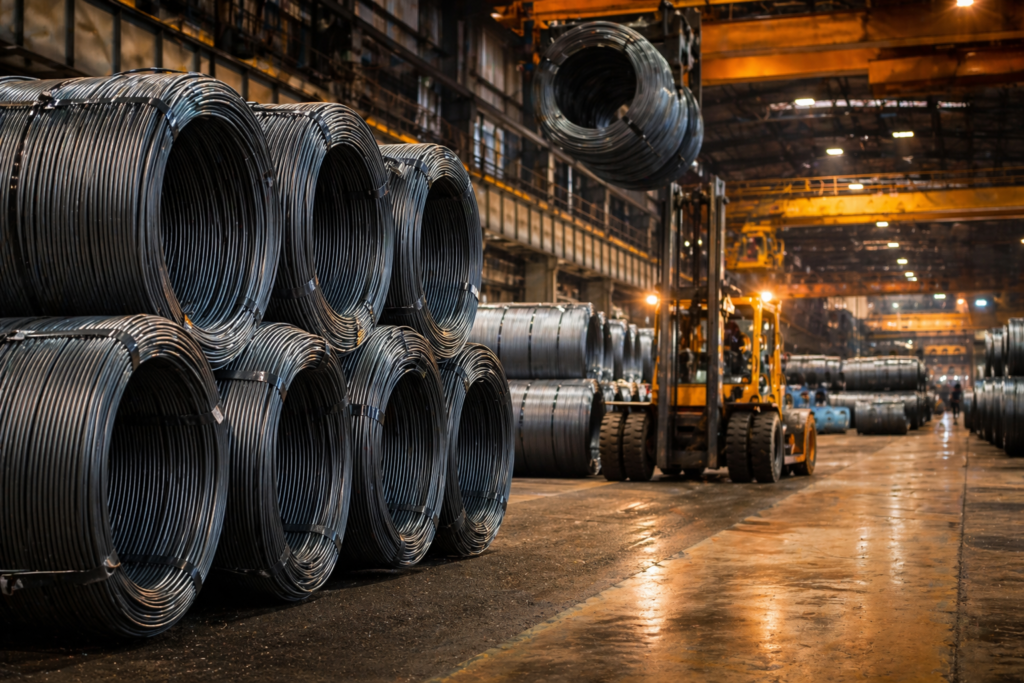
- What Is Wire Rod and How Is It Made
The seven major classification societies — Lloyd’s Register, Bureau Veritas, DNV, ABS, ClassNK, RINA, and KR — collectively publish the Rules for Materials and Welding that govern steel used in ship construction. These rules define grades, mechanical requirements, chemical composition limits, inspection requirements, and the approval procedures for steel mills. Only plates produced by approved mills carrying the classification society mark are acceptable for hull construction.
Classification steel plates are produced to normal-strength (Grade A, B, D, E) and high-strength categories. Normal-strength grades have a minimum yield strength of 235 MPa. High-strength plates are grouped into three yield strength levels: AH/DH/EH grades at 315 MPa minimum, FH/AH36/DH36/EH36 at 355 MPa minimum, and AH40/DH40/EH40 at 390 MPa minimum.
- Key Wire Rod Grades and Their Applications3+
Low-carbon wire rod (C content below 0.15%) is the primary feedstock for cold heading and forging of fasteners, bolts, rivets, and nails. Medium-carbon grades (C 0.25–0.55%)
are used for general-purpose spring wire, welding wire, and mechanical wire products. High-carbon grades (C 0.60–0.85%) are drawn into high-strength wire for prestressing strand, tire cord reinforcement, and piano wire applications requiring very high tensile strength.
Surface quality requirements vary significantly by downstream application. Fastener-grade wire rod must be free of seams, laps, and surface cracks that would open during cold heading, causing part rejection. Tire cord steel requires ultra-clean steel chemistry with minimal non-metallic inclusions to allow drawing to wire diameters below 0.3mm without breakage. Global Steel Industries can specify and source wire rod appropriate for each downstream application.
- Cold Drawing and Wire Products
Wire rod is converted into finished wire products through cold drawing — pulling the rod through a series of progressively smaller tungsten carbide dies to reduce diameter and simultaneously increase tensile strength through work hardening. A 10mm wire rod may be drawn down to 3mm finished wire, with intermediate annealing treatments to restore ductility as required.
Final wire products include galvanized wire for fencing, armouring cable, and industrial applications; PC (prestressed concrete) wire and strand for post-tensioned concrete construction; welding wire and electrodes; spring wire for automotive and industrial springs; and stainless steel wire for architectural weave mesh, marine hardware, and filtration applications.
- Market Demand and Sourcing
Global wire rod consumption tracks manufacturing activity in automotive, construction, and infrastructure sectors. India is both a significant producer and consumer of wire rod, with domestic production capacity at major integrated steel plants supplemented by imports of specialty grades not produced locally. Global Steel Industries maintains supply relationships with wire rod producers in India and internationally, ensuring competitive pricing and reliable availability for clients with high-volume requirements.
- Conclusion
Wire rod is the starting point for hundreds of end products essential to modern industry and construction. Global Steel Industries offers wire rod supply in a wide range of grades, diameters, and coil specifications with full quality documentation. Inquire at globalsteelind.com for pricing and availability.
Ready to source premium steel? Contact Global Steel Industries at globalsteelind.com or call 9324799893 / 9920397998