TMT Bars vs CTD Bars: Understanding Modern Rebar Technology
The choice of reinforcing steel profoundly impacts the safety, durability, and economy of concrete structures. For decades, Cold Twisted Deformed (CTD) bars were the construction industry standard. Today, Thermo-Mechanically Treated (TMT) bars have become the dominant choice for modern construction — offering superior mechanical properties, weldability, and seismic performance. Global Steel Industries supplies certified TMT bars in a comprehensive range of grades for construction projects across India and international markets.
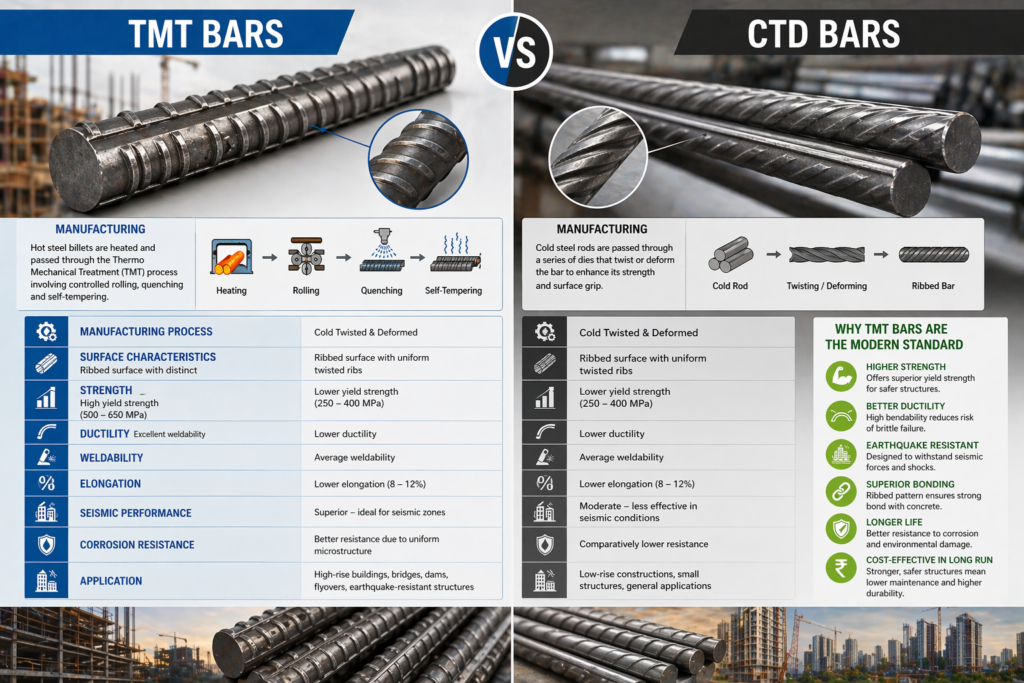
- How CTD Bars Are Manufactured
Cold Twisted Deformed bars are produced by cold working hot-rolled mild steel bars. The bar is twisted along its longitudinal axis after rolling, creating a helical rib pattern and introducing residual stresses into the material. This cold working process increases the yield strength of the bar through strain hardening. While CTD bars represented a significant improvement over plain mild steel bars when introduced, their manufacturing method has fundamental limitations.
The residual stresses introduced by cold twisting reduce the ductility and weldability of the bars. The uniform helical twist pattern offers less efficient mechanical bond with concrete compared to modern transverse rib patterns. More critically, the strength-enhancing effects of cold working are lost if the bars are exposed to elevated temperatures — a serious concern in fire scenarios.
- The TMT Manufacturing Advantage
Thermo-Mechanically Treated bars use a sophisticated controlled quenching process that creates a unique cross-sectional microstructure. Hot-rolled bars exit the rolling mill and immediately pass through a water quenching box (Tempcore system), where the outer surface is rapidly quenched, transforming it into a hard martensite layer. The retained heat from the bar’s core then self-tempers this outer martensite layer into a tough tempered martensite, while the core remains as a soft ferrite-pearlite structure.
This gradient microstructure is the key to TMT bars’ exceptional performance. The hard outer surface provides high yield and tensile strength, while the ductile ferritic-pearlitic core provides elongation, toughness, and energy absorption under seismic loading. No residual stresses are introduced by twisting, resulting in superior weldability and fire resistance compared to CTD bars.
- Grade Comparison: Fe 415, Fe 500, Fe 550
Indian Standard IS 1786 defines the grades for high-strength deformed bars used in India’s construction industry. Fe 415 (minimum yield strength 415 MPa) is the entry-level grade, now largely being replaced by Fe 500 and Fe 500D in most construction specifications. Fe 500 (minimum yield 500 MPa) is the current standard-issue grade for most residential and commercial construction.
Fe 500D and Fe 550D carry additional requirements for ductility — higher minimum elongation and restricted yield-to-tensile strength ratios — making them mandatory for construction in seismic zones III, IV, and V under Indian standards. The ‘D’ suffix signifies enhanced ductility, a critical requirement for structures designed to survive earthquake loading through energy-absorbing plastic deformation.
- Fire Resistance and Weldability
Fire resistance is a critical advantage of TMT bars over CTD bars. Because TMT bars achieve their strength through thermomechanical treatment rather than cold working, their strength properties are retained at elevated temperatures significantly better than cold-worked bars. Studies show TMT bars retain their original strength up to approximately
300°C, while cold-worked bars begin to lose their cold-work-induced strength enhancement at temperatures above 200°C.
Weldability is another significant advantage. The lower carbon equivalent of TMT bars means they can be welded without the stringent preheat requirements that apply to cold-worked bars. This simplifies connection detailing and reduces fabrication costs in precast and composite construction.
- Conclusion
TMT bars represent a clear advancement over CTD bars in every performance parameter that matters: strength, ductility, weldability, corrosion resistance, and fire resistance. Global Steel Industries supplies IS 1786 certified TMT bars in Fe 500, Fe 500D, and Fe 550D grades for demanding construction projects. Contact us at globalsteelind.com for specifications and pricing.
Ready to source premium steel? Contact Global Steel Industries at globalsteelind.com or call 9324799893 / 9920397998