Steel Surface Treatments: Hot-Dip Galvanizing, Powder Coating & More
- Why Surface Treatment Matters
Bare carbon steel is thermodynamically unstable in contact with air and moisture — it corrodes. Left unprotected, a steel structure in a moderate outdoor environment will lose approximately 75–150 μm of surface metal per year through general corrosion, with localised attack proceeding far faster. Surface treatment is therefore not optional for the vast majority of steel structures — it is a fundamental design requirement that determines service life, maintenance cost, and lifecycle economics.
The choice of surface treatment system depends on the environment (indoor, outdoor, marine, chemical), the required service life, the substrate preparation achievable, and the acceptable maintenance regime. Global Steel Industries supplies surface-treated steel products — hot-dip galvanized sections, pre-painted coils, and powder-coated fabrications — for a broad range of applications.
- Hot-Dip Galvanizing: The Gold Standard for Structural Steel
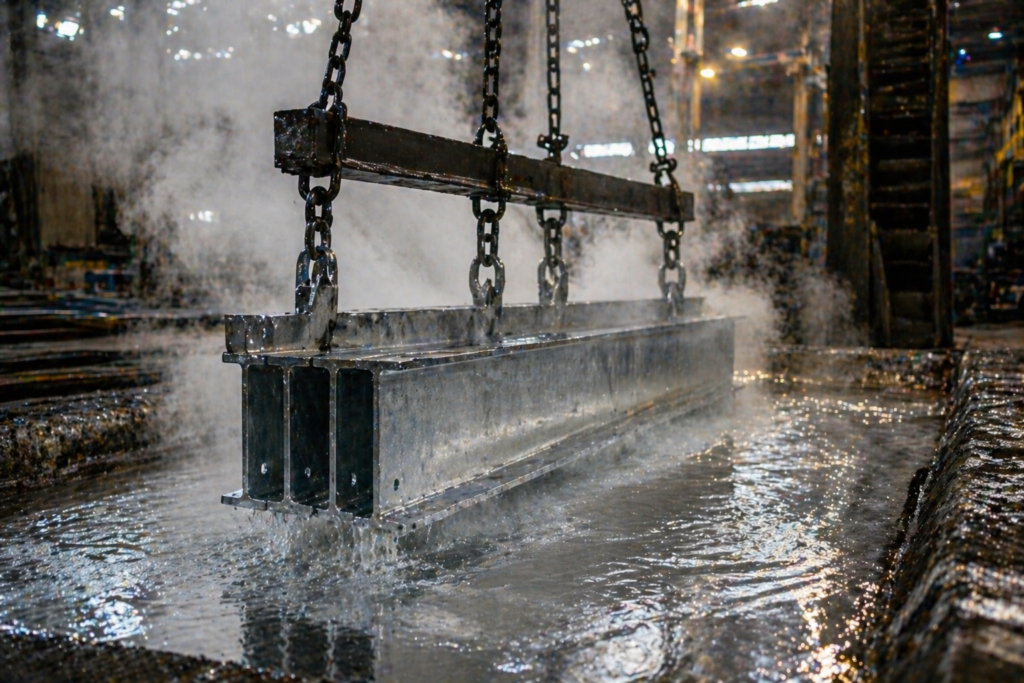
Hot-dip galvanizing immerses clean steel in a bath of molten zinc at approximately 450°C, producing a metallurgically bonded zinc-iron alloy coating. The outer pure zinc layer provides barrier protection and — critically — cathodic (sacrificial) protection at any damaged area, preventing underfilm corrosion that would progress under paint coatings. IS 2629 and ISO 1461 govern the hot-dip galvanizing process for fabricated steel, while IS 277 and ISO 3575 cover galvanized steel sheet.
Coating thickness for structural fabrications per IS 2629 is minimum 45 μm for sections under 3mm thick, rising to 85 μm minimum for sections over 6mm. In rural atmospheric environments, this provides 50+ years of maintenance-free service. In marine environments, service life is shorter (20–30 years) but still far superior to paint-only systems. Global Steel Industries supplies hot-dip galvanized structural sections, pipes, tubes, and fabrications.
- Powder Coating: Performance and Aesthetics Combined
Powder coating applies a dry thermosetting polymer powder electrostatically to the steel surface, which is then cured in an oven at 160–200°C, melting and cross-linking the polymer into a smooth, hard film. Typical film thickness is 60–100 μm, available in thousands of RAL and custom colours. Powder coatings offer excellent UV resistance, impact resistance, and weathering performance — significantly better than air-drying paint — while eliminating solvent emissions.
For outdoor structural steel applications such as modular buildings, industrial racking, street furniture, and agricultural equipment, powder-coated galvanized steel (duplex system) delivers exceptional durability: the galvanising provides cathodic protection at any coating damage site, while the powder coat provides the aesthetics and primary barrier protection. Typical duplex system service life in a moderate environment is 30–50 years before first maintenance.
- Electroplating: Precision Corrosion Protection
Electroplating deposits a thin, uniform metallic coating on steel through electrochemical reduction. Zinc electroplating (electro-galvanizing) deposits 5–25 μm of pure zinc on the steel surface, providing corrosion protection for fasteners, automotive body components, and precision parts where the thick coatings of hot-dip galvanizing would interfere with dimensional tolerances. Chromate passivation of the zinc layer improves corrosion resistance and provides the characteristic yellow, blue, or clear iridescent appearance.
Nickel plating provides a decorative, corrosion-resistant surface for hardware and automotive trim. Chrome plating delivers a very hard (HV 700–900), wear-resistant surface for hydraulic cylinder rods, precision shafts, and pump plungers operating in severe sliding wear conditions. Hard chrome plating typically applies 25–250 μm of deposit, significantly increasing surface hardness and wear resistance.
- Thermal Spray Coatings
Thermal spray processes — including flame spray, arc spray, and plasma spray — deposit metallic or ceramic particles at high velocity onto the steel surface, building up coatings of 50 μm to several millimeters thickness. Zinc and aluminium thermal spray coatings are used for corrosion protection of large steel structures including bridges, offshore platforms, and industrial equipment where hot-dip galvanizing is impractical due to component size.
Thermal spray tungsten carbide coatings deliver exceptional wear resistance (HV 1200–1500) for pump impellers, valve seats, hydraulic cylinder rods, and mixing blades exposed to abrasive slurry service. Thermal spray aluminium oxide coatings provide thermal barrier and electrical insulation properties for industrial components.
- Conclusion
The right surface treatment system multiplies the service life of steel structures while controlling lifecycle maintenance costs. Global Steel Industries supplies treated and coated steel products appropriate for your specific environmental and service requirements. Contact us at globalsteelind.com to discuss surface treatment specifications.
Click here
Ready to source premium steel? Contact Global Steel Industries at globalsteelind.com or call 9324799893 / 9920397998