Steel Storage Tanks: Materials, Design Considerations & Industry Standards
Atmospheric and low-pressure storage tanks are essential infrastructure in the oil and gas, chemical, water treatment, and food industries. Containing millions of litres of hydrocarbons, chemicals, or water, the structural integrity and corrosion resistance of these tanks directly impact operational safety and environmental protection. The quality of the steel plates used in tank construction is therefore of paramount importance. Global Steel Industries supplies API 650-grade and AWWA-grade steel plates for storage tank fabrication across global markets.
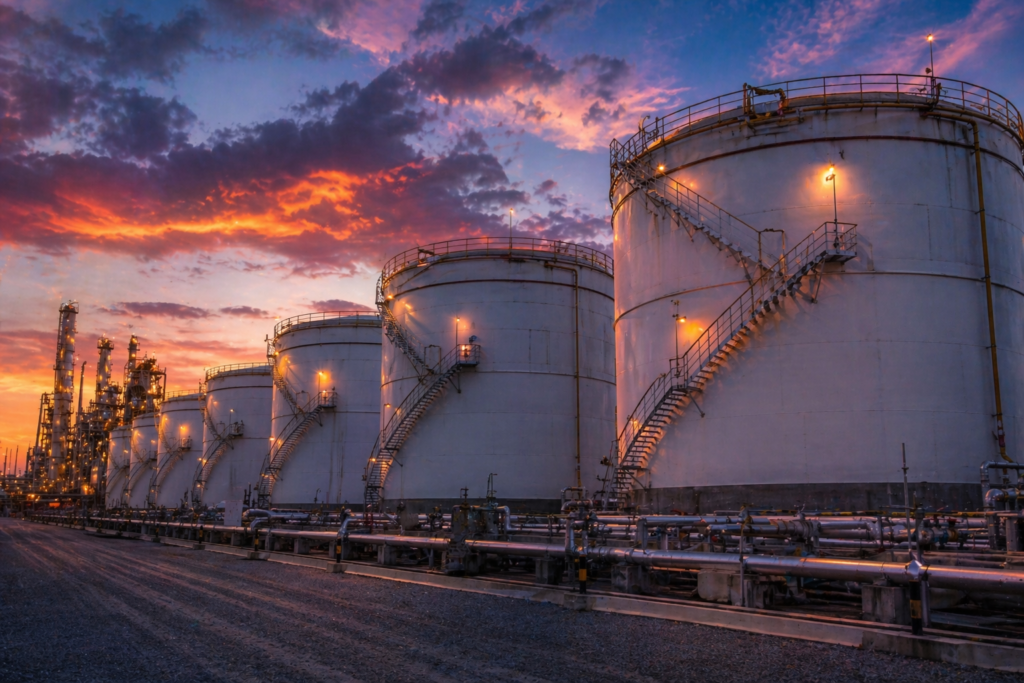
- API 650 Standard for Atmospheric Storage Tanks
API Standard 650 is the definitive design and construction standard for welded steel tanks used for oil storage at atmospheric pressure. It specifies material requirements, design procedures for shell course sizing, roof design, foundation requirements, and inspection and testing procedures. Materials approved for API 650 tank shells include ASTM A36, A283 Grade C and D, A285 Grade C, A131 Grade A and B, A516 all grades, and high-strength grades including A537 and A573.
The choice of plate grade for a specific tank is driven by design temperature, stored fluid properties, required corrosion allowance, and economics. Most ambient-temperature petroleum tanks use A36 or A283C for lower courses and A516-70 for bottom and lower shell plates. For low-temperature service tanks, A516-70 with Charpy impact testing is specified. For tanks storing corrosive chemicals, stainless steel shell and bottom plates may be required.
- Shell Course Design and Plate Thickness
Tank shells are designed in courses — rings of horizontally welded plates that increase in thickness from the top of the tank to the bottom, reflecting the increasing hydrostatic pressure from the stored fluid. The thickest plates are at the bottom course, where hydrostatic head is maximum. Plate thicknesses in large diameter tanks can range from 6mm in upper courses to 30mm or more in the lowest course for very large tanks.
Plate dimensions for tank courses are carefully calculated to minimize waste and weld joints. Standard plate widths of 1500mm, 1800mm, and 2000mm are matched to the course height requirements. Length is selected to minimize the number of vertical seams in each course. Global Steel Industries supplies tank plates in optimized dimensions to reduce material waste and fabrication cost
- Corrosion Protection Strategies
Storage tanks are exposed to corrosion from both internal and external sources. Internal corrosion is driven by the stored product — water bottoms in petroleum tanks, acidic chemicals, or oxygenated water — and is controlled through internal linings, cathodic protection systems, and regular inspection and maintenance. External corrosion of tank shells and roofs is controlled through surface preparation and painting systems in accordance with SSPC standards.
For tanks storing corrosive products, stainless steel internal linings or solid stainless steel construction provides the necessary corrosion resistance. Glass-fused-to-steel linings are an economical alternative for water and wastewater storage. Global Steel Industries can advise on material selection strategies to balance initial capital cost against long-term maintenance requirements.
- Quality and Inspection
Tank plate procurement for API 650 construction requires documented quality assurance at every stage. Mill test certificates conforming to EN 10204 3.1 or ASTM A6 requirements are mandatory. Dimensional inspection of plates before fabrication begins ensures that specified thicknesses and dimensions are met. All shell and bottom welds are subject to
radiographic, ultrasonic, or vacuum box testing as specified in API 650. The completed tank undergoes water fill testing to verify structural integrity before being placed in service.
- Conclusion
Storage tank construction demands steel plates that consistently meet API 650 specification requirements with complete documentation and traceability. Global Steel Industries delivers this reliability on every order. Contact us at globalstaeelind.com to discuss your tank plate requirements.
Ready to source premium steel? Contact Global Steel Industries at globalsteelind.com or call 9324799893 / 9920397998