Steel Rebars in Construction: Why Grade and Quality Matter

Steel rebars — formally known as reinforcing bars — are the tensile backbone of concrete structures. Concrete is extraordinarily strong in compression but brittle and weak in tension. Steel rebar embedded within concrete creates a composite material, reinforced concrete, that resists both compressive and tensile forces. The quality and grade of rebar used in construction directly determines the safety, durability, and longevity of the structure.
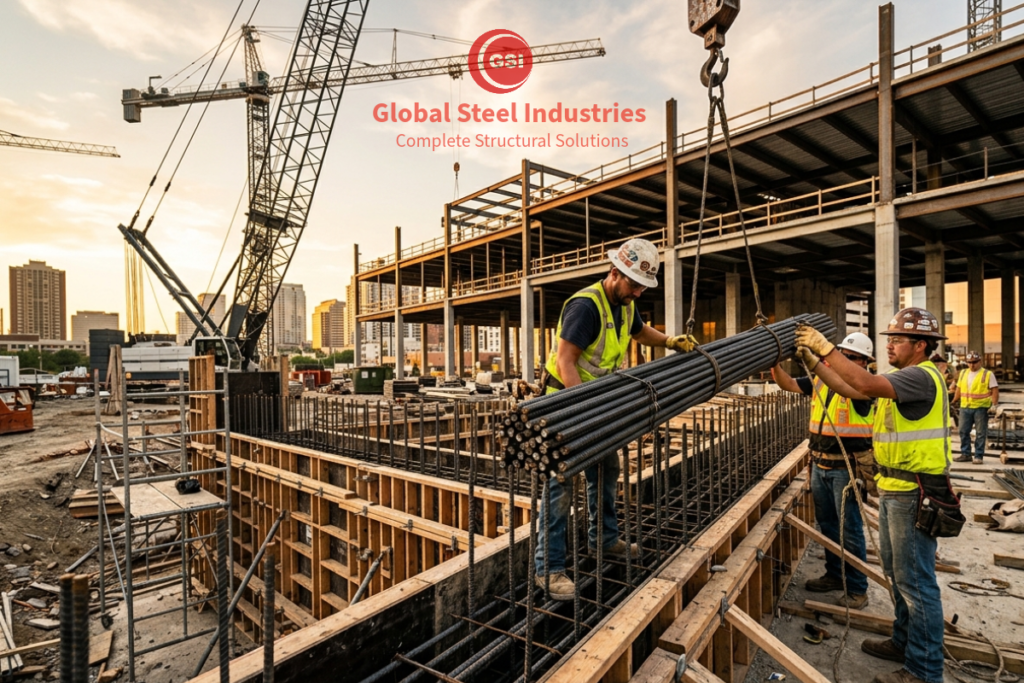
The effectiveness of reinforced concrete depends on the bond between the concrete matrix and the steel rebar. Deformed rebars — which feature raised ribs and lugs on their surface — interlock mechanically with the surrounding concrete, preventing relative movement under load. This mechanical bond is supplemented by chemical adhesion and friction. When a reinforced concrete beam is loaded, the concrete carries compression while the embedded rebars resist tension. The result is a structural element capable of spanning distances and carrying loads that plain concrete could never achieve. The integrity of this system depends entirely on the consistent quality and reliable mechanical properties of the rebar.
Rebar is manufactured in various yield strength grades to suit different structural applications. Internationally recognized standards define specific minimum yield strength, tensile strength, elongation, and chemical composition requirements. Common grades include Fe 415, Fe 500, and Fe 550 under Indian Standard IS 1786, and Grade 40, Grade 60, and Grade 75 under ASTM A615. Higher-grade rebars allow engineers to achieve the required structural strength with less material, reducing overall weight and cost. However, the choice of grade must be carefully matched to the design requirements, welding procedures, and ductility demands of the structure. Global Steel Industries supplies rebars across the full range of grades with complete documentation and certifications.
The consequences of using substandard or counterfeit rebar in construction are devastating. Rebars with insufficient yield strength may deform under design loads, causing premature structural failure. Excessive carbon content or incorrect alloying can make rebar brittle, leading to sudden fracture rather than gradual yielding — a critical safety hazard in earthquake-prone regions. Poor surface quality, excessive corrosion, or incorrect dimensions can compromise the bond between rebar and concrete. Investigations of structural failures worldwide have repeatedly identified substandard reinforcing steel as a contributing factor. This is why sourcing rebar from certified, reputable suppliers with verifiable quality management systems is absolutely non-negotiable.
In seismically active regions, rebar must not only meet minimum strength requirements but also demonstrate adequate ductility — the ability to deform significantly before fracturing. During an earthquake, a well-designed reinforced concrete structure is intended to dissipate seismic energy through controlled plastic deformation of the rebars, preventing catastrophic brittle collapse. Seismic-grade rebars must meet additional requirements for yield-to-tensile strength ratios and uniform elongation. These properties ensure the structural system behaves in a predictable, energy-absorbing manner under seismic loading. Global Steel Industries can supply rebars meeting seismic design requirements for critical construction projects.
Maintaining rebar quality from the mill to the construction site requires proper storage and handling practices. Rebars should be stored on elevated platforms to prevent ground contact and moisture accumulation. They should be protected from prolonged exposure to rainfall and aggressive industrial atmospheres. Mill scale and light surface rust are generally acceptable, but deep pitting corrosion reduces the effective cross-section and compromises performance. Global Steel Industries ensures that all rebar deliveries are accompanied by complete mill test certificates, allowing site engineers to verify the chemical and mechanical properties of every batch received.

Steel rebars are arguably the most safety-critical component in concrete construction. The grade, chemical composition, mechanical properties, and surface quality of the rebar you specify directly impact structural integrity. Trust Global Steel Industries for certified, quality-assured rebars that meet the demands of your most critical projects. Contact us at globalsteelind.com for specifications and competitive pricing. Click here 

Ready to source premium steel? Contact Global Steel Industries at globalsteelind.com or call 9324799893 / 9920397998

Scroll to Top