Steel in the Cement Industry: Grinding Media, Mill Liners & Structural Needs
- Steel as an Enabler of Cement Production
The cement industry is one of the most steel-intensive manufacturing sectors, consuming steel not merely in its structural infrastructure but as a critical consumable in the grinding and crushing operations that convert raw limestone and clinker into finished cement. The balls, hammers, liners, and rollers that grind raw materials and clinker to the required particle fineness must survive a relentless combination of impact and abrasion — demanding steel grades engineered specifically for wear resistance. Global Steel Industries supplies wear-resistant steel products to cement plants across India and internationally.
- Hot-Dip Galvanizing: The Gold Standard for Structural Steel
Hot-dip galvanizing immerses clean steel in a bath of molten zinc at approximately 450°C, producing a metallurgically bonded zinc-iron alloy coating. The outer pure zinc layer provides barrier protection and — critically — cathodic (sacrificial) protection at any damaged area, preventing underfilm corrosion that would progress under paint coatings. IS 2629 and ISO 1461 govern the hot-dip galvanizing process for fabricated steel, while IS 277 and ISO 3575 cover galvanized steel sheet.
Coating thickness for structural fabrications per IS 2629 is minimum 45 μm for sections under 3mm thick, rising to 85 μm minimum for sections over 6mm. In rural atmospheric environments, this provides 50+ years of maintenance-free service. In marine environments, service life is shorter (20–30 years) but still far superior to paint-only systems. Global Steel Industries supplies hot-dip galvanized structural sections, pipes, tubes, and fabrications.
- Grinding Media: Balls and Cylpebs
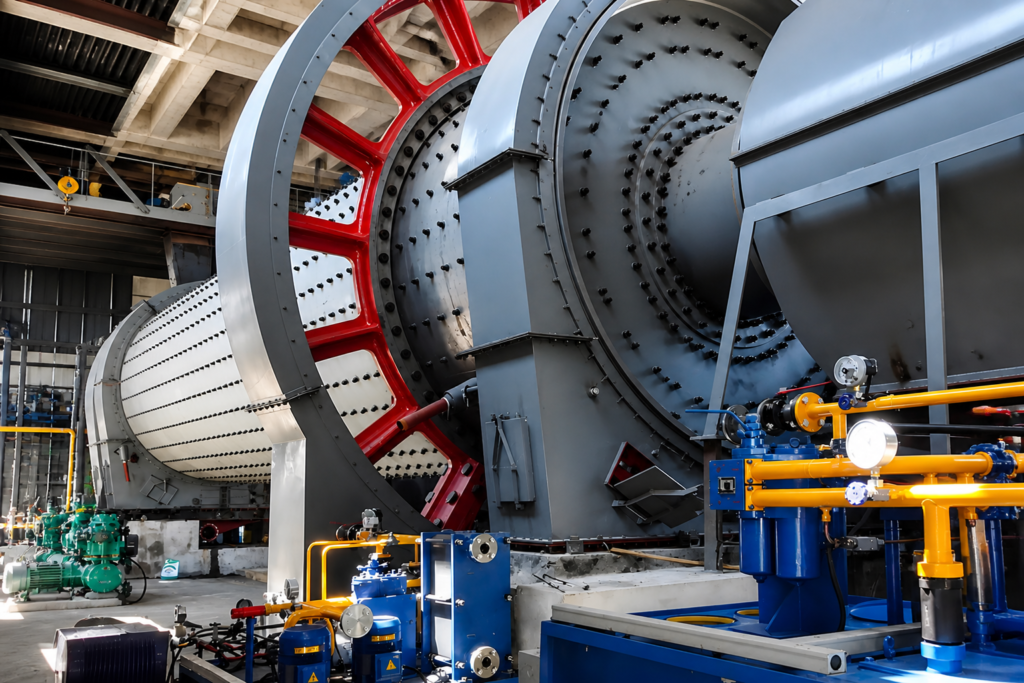
Ball mills — rotating cylindrical vessels charged with steel balls — are the primary cement grinding equipment in tube mill systems. The grinding balls must combine high surface hardness, which resists abrasive wear, with sufficient core toughness to resist fracture under impact loading. Forged and cast grinding balls are produced in high-carbon (0.7–1.0% C) chrome-moly alloys, achieving surface hardness of HRC 60–65 through heat treatment.
Ball diameters range from 15mm (used in the fine-grinding compartment) to 100mm (in the coarse-grinding compartment). Larger balls deliver more impact energy for coarse size reduction, while smaller balls provide more surface area per unit volume for fine grinding. Ball consumption in cement mills is typically 100–400 g per tonne of cement produced, making grinding media a significant operational cost that is directly influenced by ball quality and hardness.
- Mill Liner Plates: Protecting the Shell
Mill liner plates protect the cylindrical shell of ball mills from direct impact and abrasion by the grinding charge. They also impart energy to the grinding balls through their lifting profile, promoting efficient cascading and cataracting motion. Liners are typically cast from manganese steel (12–14% Mn, Hadfield’s steel) or high-chrome white iron, with hardness of 450–700 HBW depending on the grade.
Austenitic manganese steel (Hadfield’s steel) work-hardens under impact, developing surface hardness of 400–500 HBW from an as-cast 180–220 HBW while retaining an extremely tough core — preventing the catastrophic fracture that would occur with a fully hard, brittle liner. Chrome-moly steel liners offer higher as-installed hardness for applications dominated by abrasion rather than impact.
- Crusher Hammers and Impact Plates
Jaw crushers, hammer mills, and impact crushers reduce limestone, clinker, and other raw materials to the size required for ball mill feed. Crusher wear parts — hammers, blow bars, jaw plates, and cheek plates — experience severe impact and abrasion. Martensitic chromium white iron (15–28% Cr) and high-manganese steel are the dominant materials, with chrome iron preferred for high-abrasion applications and manganese steel for high-impact service.
Proper material selection for crusher wear parts requires understanding of the feed material abrasion index and impact energy. High silica content in the feed favours high-chrome iron; clay-bearing materials with lower abrasivity allow manganese steel with better impact performance. Global Steel Industries supplies crusher wear parts and mill liners to cement plant specifications.
- Structural Steel Requirements
Beyond the grinding and crushing equipment, cement plants contain extensive structural steel in the form of pre-engineered building structures for silos, packing buildings, and machine houses; conveyor support gantries and transfer towers; structural frames for kilns, preheater towers, and clinker coolers; piping racks and electrical cable trays. All are specified to standard structural grades (IS 2062, ASTM A36, or equivalent) with hot-dip galvanizing or paint protection appropriate to the dusty, humid, and corrosive cement plant environment.
- Conclusion
Steel consumption in the cement industry is substantial — both as structural material and as critical consumables in grinding and crushing systems. Global Steel Industries supplies wear-resistant and structural steel products for cement plant applications. Contact us at globalsteelind.com for specifications and pricing.
Ready to source premium steel? Contact Global Steel Industries at globalsteelind.com or call 9324799893 / 9920397998