Steel in the Automotive Industry: From Body Panels to Chassis
Steel has been the dominant material in automobile manufacturing for over a century. Despite competition from aluminium and composites, steel accounts for more than 55% of a modern vehicle’s weight. Its unique combination of strength, formability, safety performance, and recyclability keeps it at the forefront of automotive design and engineering
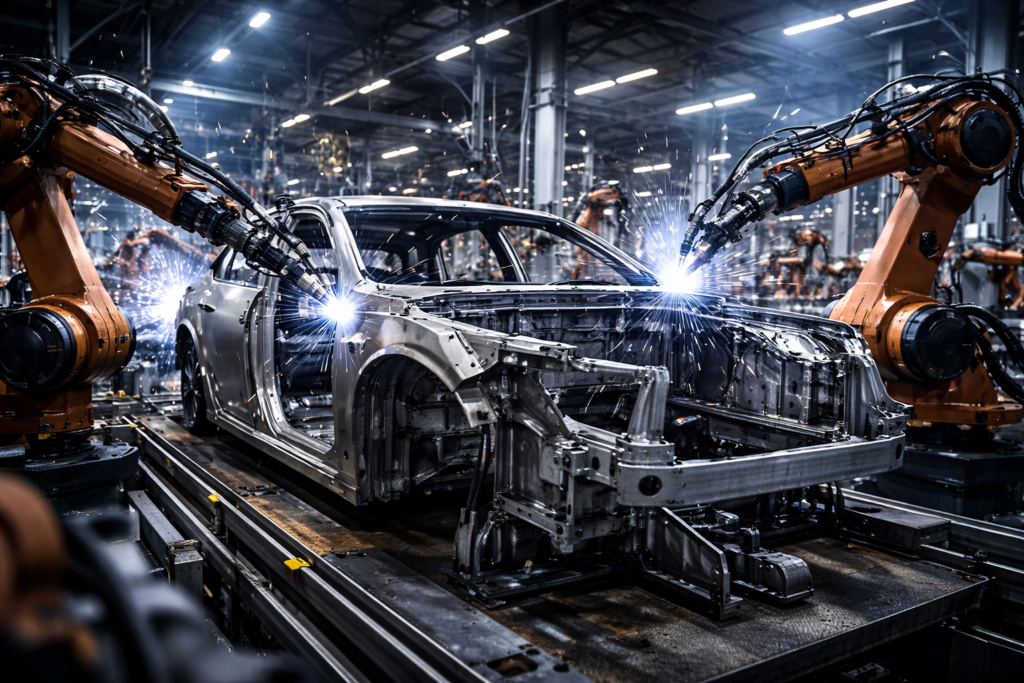
- The Steel Anatomy of a Vehicle
A typical passenger vehicle contains approximately 900 kg of steel, used across the body-in-white (the structural frame), chassis and suspension components, engine parts, exhaust systems, wheels, and reinforcements. Each application demands specific properties — from ultra-high-strength steel (UHSS) in crash zones to deep-drawing quality (DDQ) steel in body panels.
- Body-in-White (BIW) Steel
The body-in-white is the structural skeleton of a vehicle before painting or assembly. It is fabricated from cold rolled steel sheets of varying grades and thicknesses. Advanced high-strength steels (AHSS) including dual-phase (DP), transformation-induced plasticity (TRIP), and press-hardened steels (PHS) are increasingly used in the BIW to reduce weight while improving crash performance. Boron steel (22MnB5) is hot-stamped to form A-pillars, B-pillars, and rocker panels.
- Chassis and Suspension
The chassis — the vehicle’s structural platform — uses high-strength low-alloy (HSLA) steel to balance rigidity with weight reduction. Suspension components including control arms, subframes, and spring supports are machined from alloy steels with high fatigue resistance. Hollow structural sections and tubes are used extensively in cross members and crash management systems.
- Steel in Safety Structures
Modern vehicles incorporate strategic use of ultra-high-strength steel in crash energy management zones. Door intrusion beams, bumper reinforcements, and seat structures use martensitic or boron steels with tensile strengths exceeding 1500 MPa. These allow thinner, lighter sections without compromising occupant protection — a key factor in achieving 5-star safety ratings.
- Exhaust Systems & Engine Components
Stainless steel (grades 409, 441, 304) is used extensively in exhaust manifolds, mufflers, and catalytic converter housings due to its heat and corrosion resistance. Engine components including camshafts, crankshafts, and connecting rods are machined from high-alloy and tool steels capable of withstanding extreme operating temperatures and fatigue loading.
- The EV Revolution and Steel
Electric vehicles (EVs) present new demands for steel. Battery enclosures require high-strength steel with excellent formability and crash resistance. Lighter, stiffer BIW structures help offset the weight of battery packs. Electrical motor lamination steels (non-grain-oriented silicon steel) are critical for motor efficiency. The shift to EVs is accelerating demand for advanced steel grades, not displacing steel altogether.
- Conclusion
Steel remains irreplaceable in automotive manufacturing, evolving with every generation of vehicles to meet new demands for safety, efficiency, and performance. Global Steel Industries supplies automotive-grade cold rolled steel, HSLA steel, and stainless steel products meeting IS, ASTM, and EN specifications. Contact our team to discuss your automotive steel requirements.
Ready to source premium steel? Contact Global Steel Industries at globalsteelind.com or call 9324799893 / 9920397998