Steel in Mining: Wear Plates, Structural Equipment & Underground Support
- The Mining Industry's Steel Demands
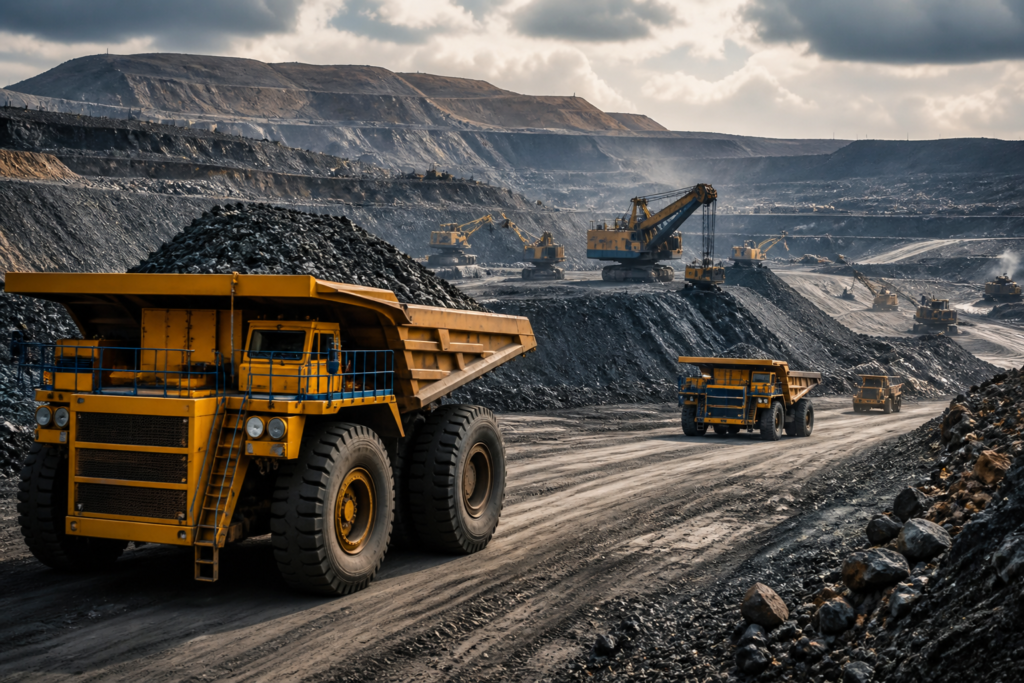
Mining is one of the most steel-intensive industries globally — and also one of the most physically demanding environments for steel in service. Rock abrasion, impact loading, high-cycle fatigue, and corrosive groundwater combine to create conditions that rapidly degrade conventional structural steels. Every component in a mine — from the ground support rock bolts holding the tunnel walls to the massive haul truck dump bodies carrying hundreds of tonnes of ore — must be engineered with materials that resist this environment. Global Steel Industries supplies abrasion-resistant and structural steel products for mining applications.
- Hot-Dip Galvanizing: The Gold Standard for Structural Steel
Hot-dip galvanizing immerses clean steel in a bath of molten zinc at approximately 450°C, producing a metallurgically bonded zinc-iron alloy coating. The outer pure zinc layer provides barrier protection and — critically — cathodic (sacrificial) protection at any damaged area, preventing underfilm corrosion that would progress under paint coatings. IS 2629 and ISO 1461 govern the hot-dip galvanizing process for fabricated steel, while IS 277 and ISO 3575 cover galvanized steel sheet.
Coating thickness for structural fabrications per IS 2629 is minimum 45 μm for sections under 3mm thick, rising to 85 μm minimum for sections over 6mm. In rural atmospheric environments, this provides 50+ years of maintenance-free service. In marine environments, service life is shorter (20–30 years) but still far superior to paint-only systems. Global Steel Industries supplies hot-dip galvanized structural sections, pipes, tubes, and fabrications.
- Abrasion-Resistant Steel Plates
Abrasion resistant (AR) steel plates are the workhorses of mining equipment, protecting chutes, hoppers, dump truck bodies, crusher liners, and conveyor skirts from the relentless abrasive action of moving ore and rock. AR steels are produced as quenched and tempered high-strength plates in hardness grades typically expressed in Brinell units: AR 400, AR 450, AR 500, and AR 600 correspond to plates with nominal hardness of 400, 450, 500, and 600 HBW respectively.
Higher hardness provides better wear resistance against abrasion but reduces ductility and weldability. The choice of AR grade depends on the abrasion index of the material being handled, the impact energy involved, and the welding requirements of the fabrication. AR 400 and AR 450 are the most widely used grades in mining, offering good wear resistance with adequate toughness for structural applications. AR 500 and AR 600 are reserved for the most severely abrasive applications where AR 400 life is unacceptably short.
- Ground Support Systems
Underground mine safety depends critically on ground support systems — rock bolts, cable bolts, mesh, and shotcrete working together to stabilise excavated tunnel walls and roofs against rock falls and stress-induced failure. Rock bolts are threaded steel rods typically 20–28mm in diameter, installed into drilled holes and tensioned to compress the rock mass and engage its natural arch strength.
Rock bolt steel must combine high tensile strength (typically 600–800 MPa yield) with excellent ductility — bolts must be able to tolerate large deformations as the rock mass yields without brittle fracture. In corrosive underground environments with acidic groundwater or ammonium nitrate blasting residues, galvanized or epoxy-coated rock bolts extend service life and maintain load-bearing capacity.
- Structural Steel in Mining Equipment
Mining equipment — excavators, dozers, graders, haul trucks, and draglines — incorporates extensive structural steel in frames, arms, buckets, and structural members designed for extreme loading. High-strength low-alloy steels (HSLA) in Grade 690 and above allow structural components to be designed with thinner sections, reducing equipment weight and improving payload ratios. Bucket teeth and ground engaging tools for excavators are cast in martensitic or austenitic manganese steel for maximum wear resistance.
Conveyor systems — essential for moving ore and waste rock at every stage of mining operations — require structural steel for conveyor frames and trestles, idler frames, and take-up structures. Hot-dip galvanized steel is standard for outdoor mine conveyor structural work, providing maintenance-free corrosion protection for the typically 20–30 year design life of mine infrastructure.
- Steel in Mineral Processing Plants
Processing plants that upgrade mined ore to a saleable product — concentration mills, smelters, and refineries — require extensive structural and process steel. Thickener and clarifier tanks for tailings management are fabricated from steel plates conforming to API 650 or equivalent standards. Pressure leach vessels in hydrometallurgical processes operate under aggressive acid and high-temperature conditions demanding corrosion-resistant alloys.
Global Steel Industries supplies wear plate, AR steel, structural sections, and pressure vessel plate to mining and mineral processing specifications. Our technical team can assist with material selection for specific abrasion and impact service conditions.
- Conclusion
Mining operations demand steel that performs reliably in the harshest possible environment. Global Steel Industries supplies certified mining-grade steel products from wear plate to structural sections. Contact us at globalsteelind.com to discuss your mining project requirements.
Ready to source premium steel? Contact Global Steel Industries at globalsteelind.com or call 9324799893 / 9920397998