Steel in Desalination Plants: Material Challenges & Corrosion Solutions
Fresh water scarcity is one of the defining challenges of the 21st century, and desalination — the removal of salt from seawater — is an increasingly critical technology for water-stressed regions including the Middle East, North Africa, coastal India, and parts of Asia. Desalination plants, whether based on thermal processes (Multi-Stage Flash and Multi-Effect Distillation) or membrane technology (Reverse Osmosis), operate in one of the most corrosive environments imaginable — concentrated hot seawater loaded with chlorides. The material selection for desalination plant components is therefore an area where steel metallurgy expertise directly impacts plant reliability, operating cost, and service life. Global Steel Industries supplies specialized stainless steel, duplex, and nickel alloy products for desalination plant construction.
- The Seawater Corrosion Challenge
Seawater presents a uniquely aggressive corrosion environment for steel. Its high chloride content (approximately 19,000 ppm Cl⁻) attacks the passive films on stainless steel surfaces, initiating pitting corrosion that can perforate thin-walled components in months rather than years. Elevated temperature, which increases both corrosion rate and the concentrating effect in thermal desalination processes, makes the challenge still more severe.
Biological fouling — the attachment and growth of marine organisms on submerged surfaces — creates crevice conditions beneath biofilm deposits, creating localized corrosion cells. In multi-stage flash (MSF) plants, the combination of high velocity seawater and elevated brine temperatures creates erosion-corrosion conditions that rapidly destroy conventional materials. Selecting the right material for each service environment within a desalination plant is a complex but well-understood engineering discipline.
- Materials for Reverse Osmosis Systems
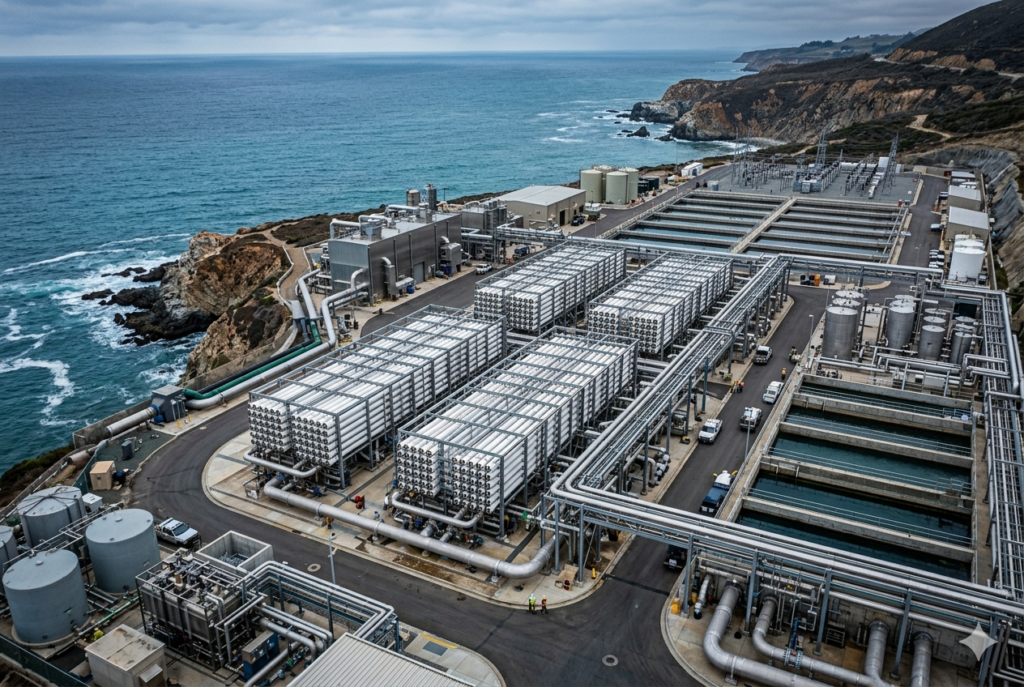
Reverse Osmosis (RO) desalination, now the dominant technology for new desalination capacity globally, passes pressurized seawater through semipermeable membranes at operating pressures of 55–70 bar. The high-pressure vessels housing RO membrane elements must combine pressure containment capability with resistance to seawater corrosion. Super duplex stainless steel Grade 2507 (UNS S32750) with its PREN exceeding 40 is the dominant material for RO pressure vessel housings, interconnect piping, and high-pressure pump components.
Seawater intake and pre-treatment systems, which handle unchlorinated seawater at ambient conditions, use Grade 316L for lower-risk components and duplex 2205 or super duplex 2507 for pump casings, heat exchanger shells, and piping in higher-velocity zones. Titanium Grade 2 is specified for condenser tubes in thermal desalination and for some RO feed piping where absolute corrosion immunity is required
- Thermal Desalination Materials
Multi-Stage Flash (MSF) plants heat seawater to approximately 115°C and flash it through successive stages at progressively lower pressures to produce distillate. The combination of high temperature and high brine concentration creates an exceptionally demanding environment. MSF heat recovery sections use duplex stainless steel or nickel alloy tubes (Alloy 825, Alloy 625) in the hottest stages, transitioning to duplex in cooler stages.
Multi-Effect Distillation (MED) plants, now preferred for new thermal capacity due to their lower energy consumption, face similar material challenges. Effect bodies are fabricated from duplex stainless or aluminum brass, while tube bundles in the hottest effects use titanium or Alloy 625 for maximum reliability. Brine heaters in MSF plants, handling the highest-temperature streams, typically use super austenitic stainless steel or nickel alloy 625 for the tube bundle.
- Cathodic Protection and Corrosion Monitoring
Even the most corrosion-resistant alloys benefit from supplementary corrosion control measures in desalination service. Impressed current cathodic protection (ICCP) or sacrificial anode systems protect submerged steel structures including intake screens, jetties, and caisson walls. Corrosion monitoring using flush-mounted probes, corrosion coupons, and online monitoring systems provides early warning of accelerated attack before it causes failure.
Water chemistry control — specifically the dosing of corrosion inhibitors, biocides, and scale inhibitors — is equally important in thermal desalination systems where the chemistry of the concentrated brine evolves through multiple stages. Global Steel Industries’ technical team can advise on material selection strategies for each zone of a desalination plant.
- Conclusion
Desalination plant construction demands the most sophisticated corrosion-resistant alloys available, combined with expert material selection expertise. Global Steel Industries supplies super duplex stainless steel, nickel alloys, and titanium products for desalination applications. Contact us at globalsteelind.com to discuss your project requirements.
Ready to source premium steel? Contact Global Steel Industries at globalsteelind.com or call 9324799893 / 9920397998