Steel in Cryogenic Applications: Low-Temperature Materials & Standards

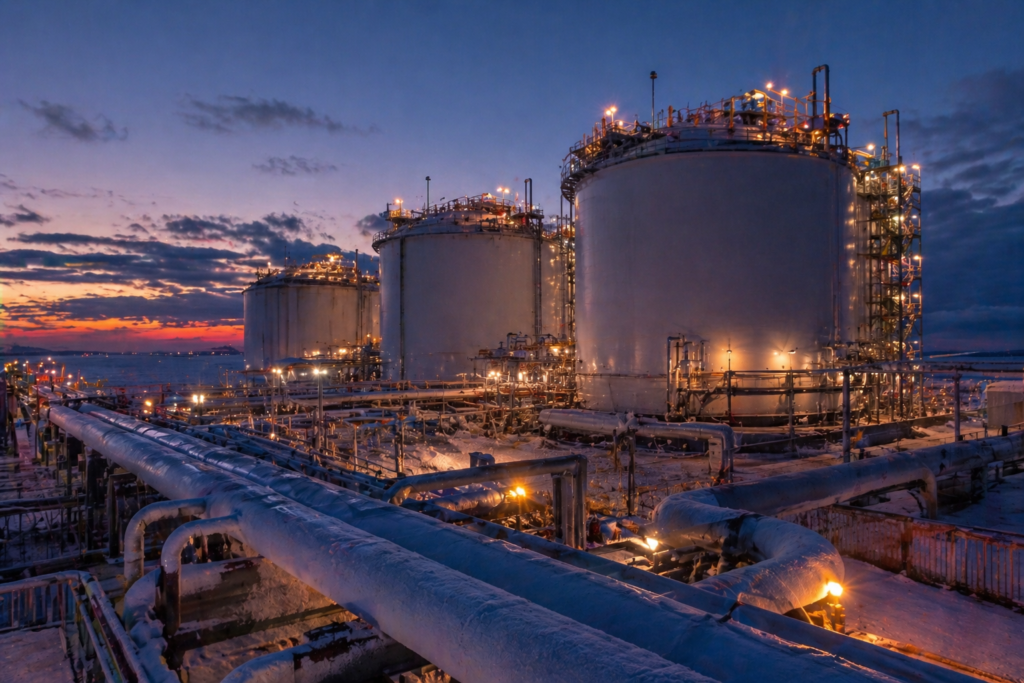
As temperatures fall below approximately 0°C, carbon and low-alloy steels undergo a progressive transition from ductile to brittle fracture behaviour. In the ductile region, a crack initiating at a defect must do significant work to propagate — energy is absorbed by plastic deformation at the crack tip, and the structure can often sustain significant damage before catastrophic failure. In the brittle region, crack propagation requires almost no energy — a crack can propagate at near the speed of sound, releasing stored elastic energy catastrophically in milliseconds. This ductile-to-brittle transition (DBT) is the fundamental design challenge for cryogenic and low-temperature steel structures. LNG storage tanks operating at −162°C (the boiling point of methane), liquid nitrogen systems at −196°C, and liquid oxygen plant at −183°C require steels specifically selected and tested to retain adequate toughness at service temperature.
Steel in Cryogenic Applications: Low-Temperature Materials & Standards
The Charpy V-Notch (CVN) impact test is the standard method for assessing a steel’s susceptibility to brittle fracture at low temperatures. A standard notched specimen is struck by a pendulum hammer, and the energy absorbed in fracturing the specimen is measured in Joules. By testing specimens at a range of temperatures, the full ductile-to-brittle transition curve is mapped — defining the transition temperature below which energy absorption falls to a specified minimum. Design codes for cryogenic and low-temperature pressure vessels — including ASME VIII, EN 13445, and BS PD 5500 — specify minimum Charpy energies at the design minimum temperature (MDMT) as a condition of material approval. The required energy varies by code and application, but 27 J at −46°C is a typical requirement for low-temperature pressure vessel service.
ASTM A333 covers seamless and welded steel pipes for low-temperature service in eight grades. Grade 6 (the most widely used) is essentially a fine-grained killed carbon steel that maintains 20 J Charpy energy at −46°C through controlled carbon content, manganese additions, and normalising heat treatment. Grade 3 (3.5% Ni) and Grade 8 (9% Ni) provide progressively lower impact transition temperatures, down to −101°C for Grade 3 and −196°C for Grade 8. ASTM A516 Grade 70 is the standard carbon steel plate for low-temperature pressure vessels down to −46°C when normalised. For service to −59°C, Grade 70 with supplementary impact testing (Supplementary Requirement S5 or S6) provides documented toughness at the lower temperature. ASTM A537 Class 1 quenched-and-tempered plate extends acceptable service to −60°C with improved toughness margins.
Nine percent nickel steel (ASTM A553 Types I and II) is the dominant structural material for flat-bottomed LNG storage tanks operating at −162°C. The 9% nickel alloying transforms the steel’s microstructure to a fine-grained, highly stable martensite with exceptional low-temperature toughness — CVN energies of 100 J or more at −196°C, compared to single-digit values for standard carbon steel at that temperature. LNG tank construction using 9% nickel steel requires qualified welding procedures with high-nickel austenitic stainless steel or nickel alloy filler metals to maintain cryogenic toughness in the weld metal. The combination of 9% nickel plate and qualified cryogenic welding practice has delivered a remarkable safety record in LNG infrastructure globally since the 1960s
Austenitic stainless steel grades 304L and 316L are inherently tough at cryogenic temperatures — their face-centred cubic (FCC) crystal structure does not exhibit the ductile-to-brittle transition that afflicts body-centred cubic ferritic and martensitic steels. They retain excellent toughness down to −269°C (liquid helium temperature) and are used for cryogenic plant components including heat exchangers, valves, instrumentation tubing, and flexible hoses. For structural applications in cryogenic vessels, 304L stainless combines cryogenic toughness with corrosion resistance and ease of welding, making it the preferred material for small LNG vessels, liquid nitrogen storage, and laboratory cryostats. Global Steel Industries supplies A333 Grade 6 and Grade 8 pipes, A553 9% Ni plates, and 304L stainless cryogenic products with appropriate low-temperature certifications.
Cryogenic steel service demands materials selected and tested specifically for low-temperature performance. Specification errors can be catastrophic. Global Steel Industries supplies certified cryogenic-grade steel products with complete documentation. Contact us at globalsteelind.com to discuss your cryogenic material requirements.

Ready to source premium steel? Contact Global Steel Industries at globalsteelind.com or call 9324799893 / 9920397998

Scroll to Top