Steel in Aerospace: Structural Frames, Landing Gear & High-Temperature Applications
- Steel's Continuing Role in Aerospace
While aluminium alloys, titanium, and carbon fibre composites dominate aerospace structural design, steel remains indispensable in specific aerospace applications where its combination of very high strength, fracture toughness, stiffness, and wear resistance cannot be matched by lighter materials at acceptable cost. Landing gear, actuation systems, engine mounts, fasteners, and bearing races are areas where high-performance steel grades deliver capabilities that justify their weight penalty. Global Steel Industries supplies specialty steel products for aerospace component manufacturers.
- Ultra-High-Strength Steels for Landing Gear
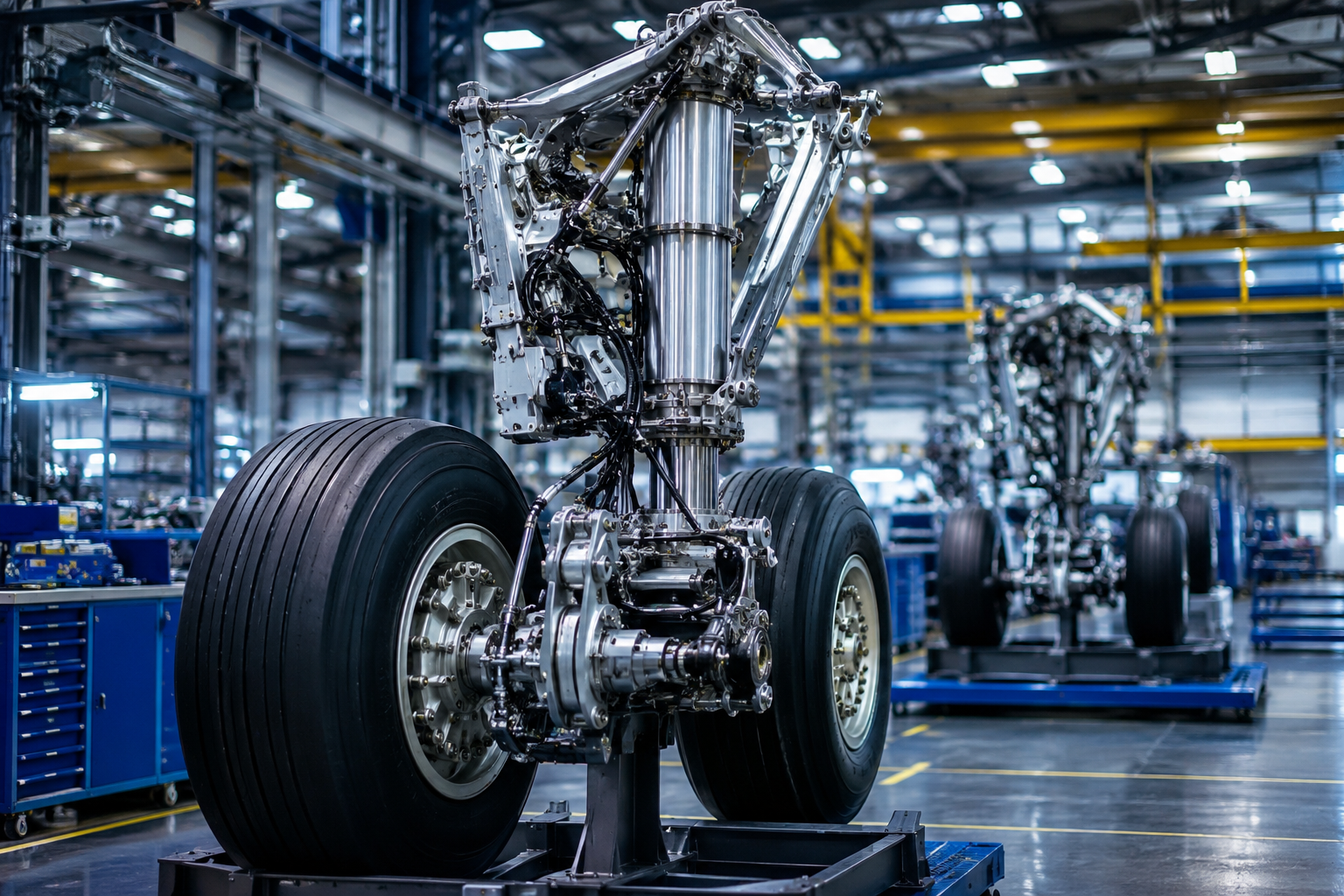
Aircraft landing gear must absorb the enormous impact energy of landing — equivalent to a controlled collision at runway speed — without yielding, cracking, or fracturing. The steel used for landing gear must achieve tensile strengths of 1,600–1,900 MPa while maintaining the fracture toughness and fatigue life needed for tens of thousands of landing cycles over a 30-year service life. This is an extraordinarily demanding combination.
300M steel (UNS S40940, 1.6% Si, 1.8% Ni, 0.4% Mo, 0.08% V) is the dominant aircraft landing gear material, achieving 1,930 MPa tensile strength at HRC 54–56 after austenitising, oil quenching, and double tempering. Its silicon addition suppresses temper embrittlement, critical for maintaining toughness at the high strength level required. Aermet 100 (13.4% Co, 11.1% Ni, 3.1% Cr, 1.2% Mo) provides even higher fracture toughness at similar strength levels for the most demanding landing gear applications.
- Maraging Steels for Aerospace Applications
Maraging steels are a unique class of ultra-high-strength steels that derive their strength from precipitation hardening (aging) of an iron-nickel martensite matrix, rather than from carbon content. Grades M250 and M300 (18% Ni, with Co, Mo, and Ti additions) achieve tensile strengths of 1,720–2,070 MPa through aging at 480°C — remarkably, with dimensional changes during heat treatment of less than 0.1%.
This combination of ultra-high strength and dimensional stability during heat treatment makes maraging steels ideal for precision components including missile airframe skins, aircraft bulkheads, jet engine shaft bolts, and tooling for composites manufacturing where die accuracy must be maintained through the curing cycle. The absence of carbon (below 0.03%) also improves weldability — maraging steel components can be welded and re-aged to restore properties.
- Stainless Steel in Aerospace Engine Applications
Gas turbine engine components in the colder sections — compressor blades and discs in the early stages, casing components, structural frames, and exhaust components — use martensitic stainless steels that combine corrosion resistance with the high strength and fatigue resistance required. Grade 17-4PH (H900 to H1150 condition) provides strength of 1,170–1,310 MPa with good corrosion resistance for compressor components and structural fittings.
Precipitation hardening stainless grades 15-5PH and 13-8Mo offer combinations of strength, toughness, and corrosion resistance that justify their use in aerospace structural applications where weight savings over lower-alloy grades are valuable. Austenitic stainless steel 321 and 347, with their excellent elevated temperature strength and oxidation resistance, are used for exhaust system components and thermal shields.
- Fasteners and Precision Components
\Aircraft structural fasteners — bolts, screws, pins, and rivets — may number in the hundreds of thousands in a modern commercial aircraft, each individually critical to structural integrity. High-strength aerospace fastener steels including A286 (austenitic stainless, 690 MPa minimum tensile), H-11 tool steel, and alloy steel 8740 are produced
to extremely tight compositional and dimensional tolerances under aerospace quality management systems.
The quality management requirements for aerospace steel supply — AS9100 certification, NADCAP-approved test laboratories, first article inspection reports, and material traceability to the originating heat — are among the most demanding in any industry. Global Steel Industries works with AS9100-certified supply chain partners to provide aerospace-grade specialty steels.
- Conclusion
Steel remains critical to aerospace applications where extreme strength-to-toughness ratios are required at acceptable weight. Global Steel Industries provides access to specialty aerospace steel grades with appropriate certifications and traceability. Contact us at globalsteelind.com to discuss your aerospace material requirements.
Ready to source premium steel? Contact Global Steel Industries at globalsteelind.com or call 9324799893 / 9920397998