Steel Fittings: Elbows, Tees, Reducers & Flanges Explained
Pipe fittings are the connective tissue of any industrial piping system. Without properly specified, quality-assured fittings at every change of direction, branch connection, or diameter transition, even the highest-quality pipes are rendered unusable. At Global Steel Industries, we supply a comprehensive range of carbon steel, stainless steel, and alloy steel pipe fittings that meet the exacting standards of the oil and gas, petrochemical, power, and water treatment industries.
- Types of Steel Pipe Fittings
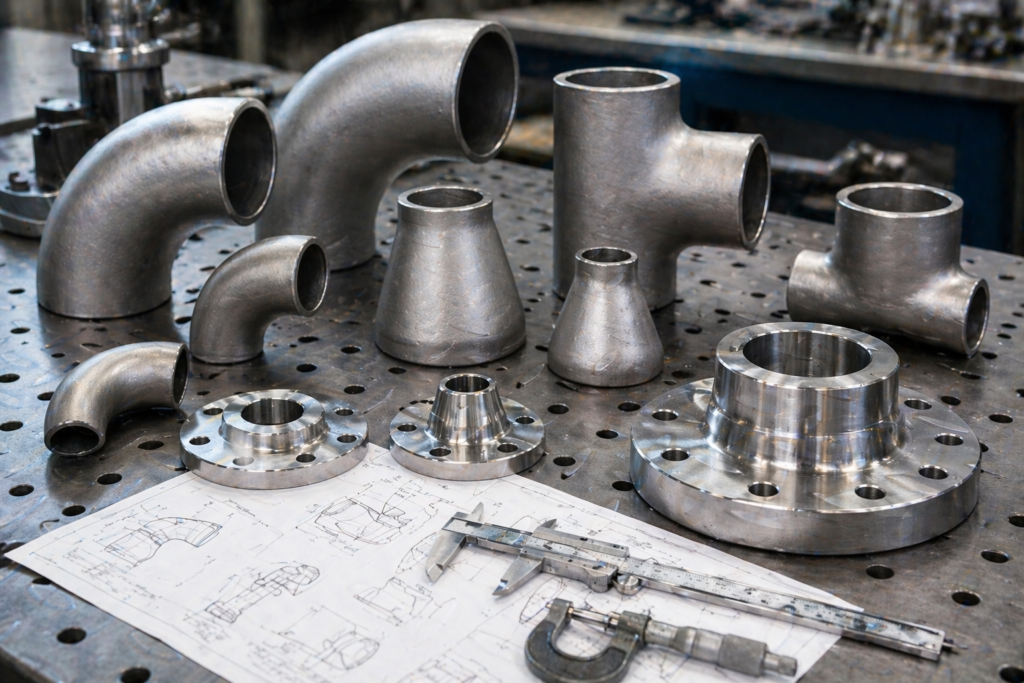
The most commonly specified pipe fittings fall into several functional categories. Elbows redirect flow direction and are available in 45-degree and 90-degree configurations, in both long-radius (LR) and short-radius (SR) variants. Long-radius elbows, with a centerline radius of 1.5 times the nominal pipe diameter, minimize pressure drop and turbulence, making them the default choice for most process applications.
Tees allow branch connections and are available in equal tees (same bore on all three outlets) and reducing tees (reduced bore on the branch outlet). Reducers connect pipes of different diameters and come in concentric and eccentric configurations — concentric reducers for vertical piping and eccentric reducers for horizontal runs where a flat bottom is required for drainage. Caps close the ends of pipes, while couplings and unions join pipes in straight runs.
- End Connections: BW, SW, and Threaded
Pipe fittings are supplied with three primary end connection types. Butt-weld (BW) fittings are welded directly to the pipe, creating a smooth internal bore with no crevices or flow restrictions — the preferred connection for high-pressure, high-temperature, and critical service piping. Socket-weld (SW) fittings accept the pipe end inside a socket and are fillet-welded externally, suitable for small-diameter, high-pressure piping up to DN50.
Threaded fittings use NPT or BSP threads and are suitable for low-pressure, non-critical utility piping. They are not recommended for high-temperature, high-pressure, or vibrating service due to the risk of thread leakage. The selection of end connection type is governed by applicable piping codes including ASME B31.3 (process piping) and ASME B31.1 (power piping).
- Standards and Pressure Classes
Steel pipe fittings are manufactured to ASME B16.9 (factory-made butt-welding fittings), ASME B16.11 (forged steel socket-welding and threaded fittings), and MSS SP-75 (high-strength butt-welding fittings). Material grades for carbon steel fittings include ASTM A234 WPB, WPC, and WP11/WP22 for alloy grades. Stainless steel fittings are typically manufactured to ASTM A403 in grades WP304L and WP316L.
Forged fittings conform to ASTM A105 for carbon steel and ASTM A182 for alloy and stainless steel grades. Pressure-temperature ratings for fittings are determined by their material grade and nominal pressure class, following ASME B16.5 tables. Proper matching of fitting pressure class to the piping system’s design conditions is essential for code compliance and safety.
- Quality and Traceability
Critical to the integrity of any piping system is the traceability of fittings back to their original mill heat. All fittings supplied by Global Steel Industries carry heat numbers and dimensional markings in accordance with applicable standards. Material test reports documenting chemical composition and mechanical properties are provided for every order. Third-party inspection by recognized agencies such as Lloyd’s, Bureau Veritas, or TÜV can be arranged upon request.
- Conclusion
Quality steel fittings from Global Steel Industries ensure the integrity and longevity of your piping systems. Whether you need standard carbon steel butt-weld fittings or exotic alloy socket-weld fittings for a critical application, our technical team can source and supply to your exact specifications. Contact us at globalsteelind.com for a comprehensive quotation.
Ready to source premium steel? Contact Global Steel Industries at globalsteelind.com or call 9324799893 / 9920397998