Steel Checkered Plates: Anti-Slip Applications & Specifications
Steel checkered plates — also known as tread plates, floor plates, or diamond plates — are steel sheets with a raised pattern on one surface that provides anti-slip properties. They are ubiquitous in industrial flooring, vehicle running boards, staircases, and platforms where safety underfoot is a priority. This guide covers types, specifications, and applications of steel checkered plates.
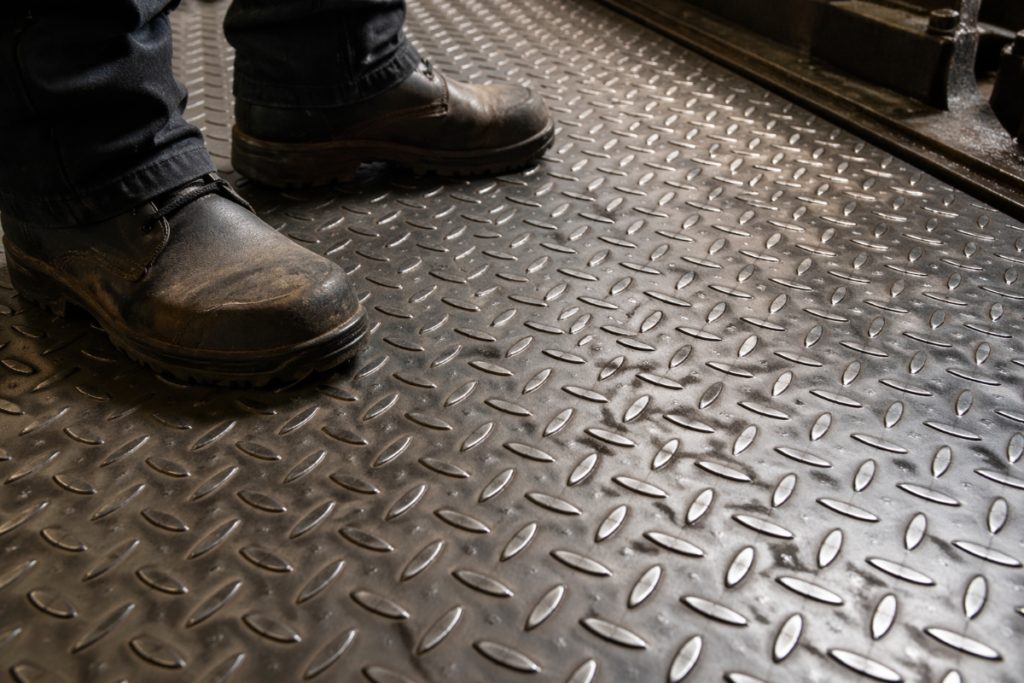
- What Is a Checkered Plate?
A checkered plate is a flat steel plate with a raised, repetitive pattern embossed on one surface during hot rolling. The raised pattern increases the coefficient of friction, preventing slipping even in wet or oily conditions. The underside remains flat for welding or bolting. Checkered plates are produced from mild steel, high tensile steel, stainless steel, and aluminium — each for different environments and load requirements.
- Common Pattern Types
Diamond/Lentil Pattern: The most common; diamond-shaped raised projections arranged in parallel rows. This is the standard ‘chequer plate’ pattern widely used in industrial flooring. Five-Bar Pattern: Five parallel raised bars arranged in an alternating pattern; offers good slip resistance and is preferred in Europe and for decorative applications. Two-Bar Pattern: Two parallel bars; lighter duty and often used for decorative trim. Teardrop Pattern: Oval-shaped raised projections; common in aluminium checkered plates.
- Standards & Specifications
Indian Standard IS 3502 covers hot-rolled steel chequered plates. International equivalents include ASTM A786 (hot-rolled steel floor plates) and EN 10024 (hot-rolled taper flange I-sections). Available thicknesses typically range from 3mm to 12mm (base plate thickness, excluding pattern height). Standard widths are 1250mm, 1500mm, and 2000mm, with lengths from 2500mm to 12,000mm. Custom sizes are available. Pattern height typically adds 0.3–1.0mm above the base thickness.
- Material Grades
Mild Steel (IS 2062 E250/E350): Most common; used in general industrial flooring, platforms, and vehicles. Hot Dip Galvanized: Mild steel base with zinc coating; for outdoor, marine, or corrosive environments. Stainless Steel (SS 304/316): For food processing, pharmaceuticals, breweries, and
chemical plants where hygiene and corrosion resistance are essential. Aluminium: Lightweight; used in vehicle running boards, aircraft, and where weight is critical. HARDOX/AR Steel: Abrasion-resistant; for mining, quarrying, and high-wear applications.
- Common Applications
Steel checkered plates are used in an enormous range of applications: industrial plant floors and walkways, truck, bus, and trailer floor panels, ship deck flooring, stair treads and landings, access platforms and mezzanine floors, ramps and loading docks, footbridges and catwalks, machinery base plates, refrigerated van floors, and decorative paneling in automotive and interior design. Their combination of anti-slip performance and structural strength makes them ideal for any application where people or vehicles move on steel surfaces.
- Selection Guide
Thickness: 3–5mm for light duty (walkways, vehicle steps); 6–10mm for medium duty (industrial floors, platforms); 10–12mm for heavy duty (loading docks, heavy vehicle floors). Pattern: Diamond for industrial/safety use; Five-bar for decorative or European applications. Material: Mild steel for general use; galvanized for outdoor/wet; stainless for food/pharma; AR steel for abrasive environments. Always check load-bearing requirements and verify span capacity before specifying thickness.
- Conclusion
Steel checkered plates are a simple but essential safety product across hundreds of industrial and commercial applications. Getting the specification right — pattern, thickness, grade, and surface treatment — ensures both safety and durability. Global Steel Industries supplies mild steel, galvanized, and stainless steel checkered plates in IS 3502 and ASTM A786 specifications, cut to size or in standard sheets. Contact us for availability and pricing.
Click here
Ready to source premium steel? Contact Global Steel Industries at globalsteelind.com or call 9324799893 / 9920397998