Stainless Steel in the Pharmaceutical Industry: Requirements & Standards
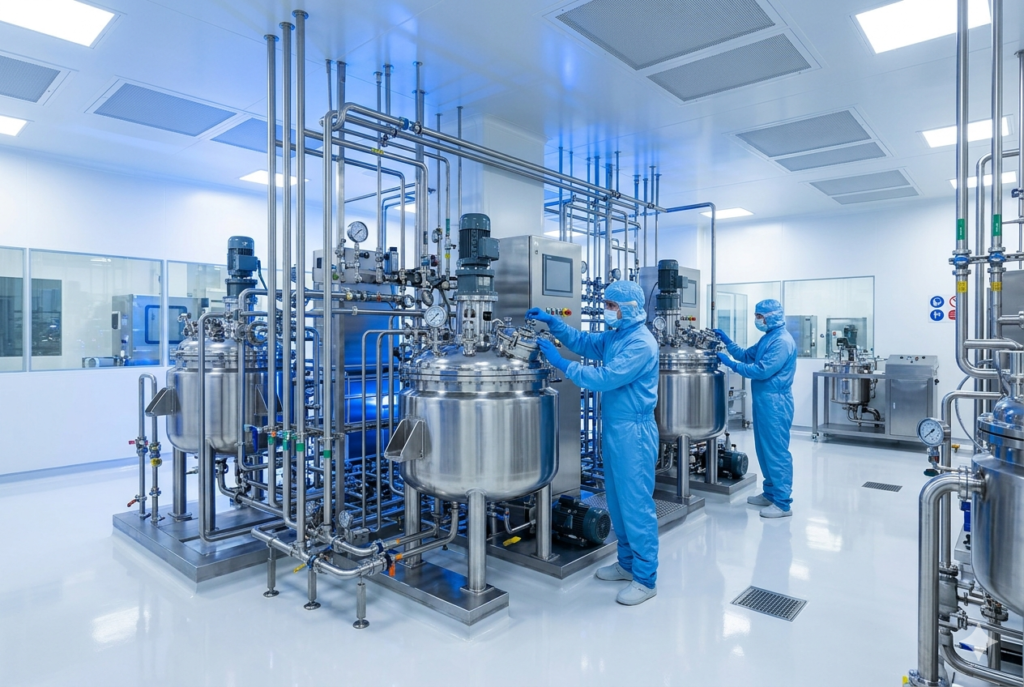
The pharmaceutical industry imposes some of the most stringent material requirements of any industrial sector. Every material that contacts pharmaceutical products — active ingredients, intermediates, solvents, or final drug formulations — must be chemically inert, capable of being cleaned and sterilized, and fully compliant with regulatory requirements from agencies including the FDA, EMA, and WHO. Stainless steel, specifically Grade 316L with controlled surface finish, has been the dominant material of construction for pharmaceutical process equipment for decades, and continues to set the standard for product quality and patient safety. Global Steel Industries supplies pharmaceutical-grade stainless steel products with the documentation required by regulated manufacturing environments.
- Why Grade 316L Is the Pharmaceutical Standard
Grade 316L stainless steel has earned its dominant position in pharmaceutical manufacturing through a combination of properties uniquely suited to the demands of drug production. Its 2–3% molybdenum content provides superior resistance to pitting corrosion in the chloride-containing cleaning agents and sanitizing solutions used in pharmaceutical facilities. The low carbon ‘L’ variant prevents sensitization during welding, ensuring corrosion resistance is maintained throughout fabricated equipment without post-weld annealing.
The passive chromium oxide layer on 316L stainless steel surfaces is chemically stable in the pH range of most pharmaceutical processes and resists attack by the organic
solvents, acids, and bases encountered in active pharmaceutical ingredient (API) synthesis. Its smooth, non-porous surface is inhospitable to microbial attachment and biofilm formation, and can be repeatedly cleaned, sanitized, and sterilized without surface degradation.
- Surface Finish Requirements and Ra Values
Surface roughness is a critical parameter for pharmaceutical stainless steel surfaces in contact with product. The roughness average (Ra) value, measured in micrometers (μm), quantifies the microscopic surface texture. Surfaces with high Ra values have deep valleys where microbial contamination and product residues can accumulate and resist cleaning. Regulatory guidance documents and industry standards specify maximum Ra values for different contact surfaces.
Pharmaceutical process vessels typically require internal Ra values ≤0.8 μm (Ra 32 microinch), with critical product contact surfaces often specified at Ra ≤0.4 μm. Sanitary tubing and fittings conforming to ASME BPE standards are electropolished to Ra ≤0.5 μm. Electropolishing not only achieves the required surface roughness but also removes surface iron contamination, enriching the passive layer and further enhancing corrosion resistance.
- ASME BPE and GMP Requirements
The ASME Bioprocessing Equipment (BPE) standard is the primary technical standard governing the design and construction of pharmaceutical processing equipment, including vessels, heat exchangers, piping, and fittings. It specifies material grades, dimensional tolerances, weld quality requirements, surface finish specifications, and documentation requirements for bioprocessing applications. ASME BPE conformance is increasingly required by pharmaceutical manufacturers and their contract manufacturing organizations.
Good Manufacturing Practice (GMP) regulations require that pharmaceutical manufacturing equipment is designed and constructed to facilitate cleaning, sanitization, and maintenance without contamination risk. Material selection must be documented in
the pharmaceutical quality system, with justification for contact materials demonstrating inertness and absence of leachable contaminants at specified processing conditions.
- Passivation and Electrolytic Polishing
Newly fabricated pharmaceutical stainless steel equipment undergoes passivation treatment to establish a corrosion-resistant chromium oxide passive layer on all product contact surfaces. Chemical passivation using citric acid or nitric acid solution removes free iron from the surface and promotes the formation of a chromium-enriched passive film. ASTM A380 provides guidance on the cleaning and descaling of stainless steel, while ASTM A967 covers chemical passivation treatments.
Electropolishing goes further than passivation — it electrochemically removes material from the surface, smoothing the microscopic roughness and simultaneously passivating the surface. The resulting surface has a higher chromium-to-iron ratio than unpolarized surfaces, significantly improving corrosion resistance and cleanability. Global Steel Industries supplies electropolished stainless tubing and components to ASME BPE Ra specifications.
- Conclusion
Pharmaceutical-grade stainless steel demands a level of quality documentation, surface specification, and regulatory compliance that goes well beyond standard industrial requirements. Global Steel Industries has the expertise and supply network to meet these demands. Contact our specialized team at globalsteelind.com to discuss your pharmaceutical stainless steel requirements.
Ready to source premium steel? Contact Global Steel Industries at globalsteelind.com or call 9324799893 / 9920397998