Mild Steel vs High Tensile Steel: Which Should You Choose?
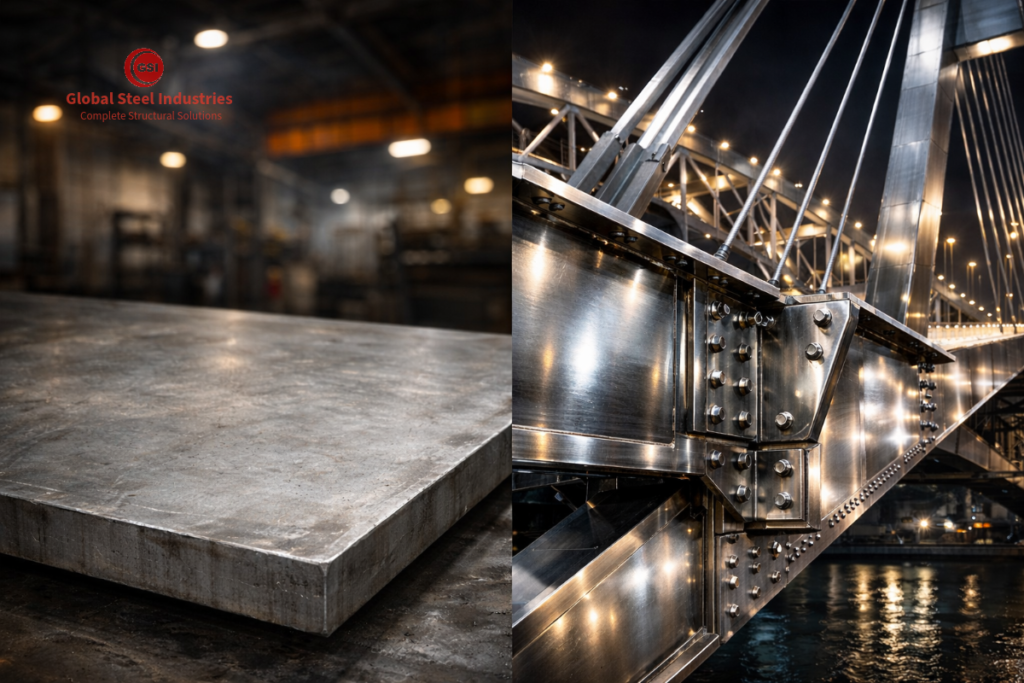
- What Is Mild Steel?
Mild steel, also called low carbon steel, contains carbon content between 0.05% and 0.25%. It is the most widely used form of steel due to its ductility, weldability, and affordability. Common grades include IS 2062 E250, ASTM A36, and S275 (EN standard). It is easy to machine, form, and weld — making it ideal for general fabrication, structural frames, pipelines, and automotive parts.
- What Is High Tensile Steel?
High tensile steel (HTS) has a carbon content ranging from 0.26% to 0.60%, along with alloying elements like manganese, silicon, and chromium. It offers significantly higher yield strength — typically 460 MPa to 690 MPa — compared to mild steel’s 250 MPa. Common grades include IS 8500, ASTM A572, EN S460, and Hardox series. It is used where strength-to-weight ratio is critical.
- Key Property Comparison
Tensile Strength: Mild steel offers 400–500 MPa while high tensile steel delivers 600–900 MPa. Yield Strength: Mild steel yields at ~250 MPa; high tensile steel at 460–690 MPa. Ductility: Mild steel is more ductile and formable; HTS is stiffer. Weldability: Mild steel is easier to weld without pre-heating; HTS may require special procedures. Cost: Mild steel is more economical; HTS carries a premium but saves weight in design.
- Applications of Mild Steel
Mild steel is the backbone of everyday fabrication. It is used in construction beams and columns, general-purpose pipes and tubes, automotive body components, furniture and shelving, agricultural equipment, and shipbuilding hulls. Its ease of processing and low cost make it the default choice for non-critical structural elements.
- Applications of High Tensile Steel
High tensile steel is preferred when weight savings and load-bearing performance are paramount. It is widely used in bridges and flyovers, cranes and heavy lifting equipment, mining and excavation machinery, pressure vessels, offshore oil and gas platforms, and high-rise building cores. Its ability to withstand extreme loads with thinner sections is a major advantage.
- Which Should You Choose?
Choose mild steel when cost-efficiency is the priority, the application requires extensive welding or forming, loads are moderate, and corrosion protection will be applied externally. Choose high tensile steel when the structure demands higher load capacity, weight reduction is critical (transport, aerospace), the project has strict section-size constraints, or long-term fatigue resistance is required. Always consult with a structural engineer and refer to relevant IS/ASTM/EN standards before finalizing material selection.
- Conclusion
Both mild steel and high tensile steel are indispensable in modern industry. The right choice depends on your project’s load requirements, budget, fabrication processes, and design constraints. Global Steel Industries supplies both mild steel and high tensile steel in plates, sheets, coils, and structural sections — with certified grades and full material traceability. Contact our technical team for grade recommendations tailored to your project needs.
Ready to source premium steel? Contact Global Steel Industries at globalsteelind.com or call 9324799893 / 9920397998