ChatGPT Image Jul 18, 2026, 10_40_20 AM

Laser Cutting Steel: Capabilities, Material Requirements & Quality Standards

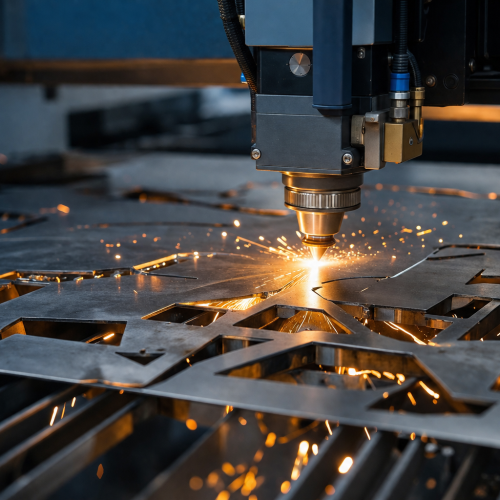
Laser cutting has transformed steel fabrication, enabling complex profiles, tight tolerances, and fine features to be cut from steel sheet and plate at speeds and accuracy levels impossible with conventional plasma or flame cutting. From intricate architectural screens to precision structural components, laser-cut steel parts are a staple of modern manufacturing. Understanding the material requirements for successful laser cutting  and the quality standards achievable — helps buyers specify appropriate plate grades for their laser cut components. Global Steel Industries supplies laser-cuttable steel sheet and plate across a range of grades

CO₂ lasers, using carbon dioxide gas as the lasing medium, dominated industrial laser cutting from the 1980s through the 2000s. They produce 10.6 μm wavelength infrared light, which is efficiently absorbed by steel and other metals. CO₂ lasers excel in cutting mild steel up to 25–30mm thickness and stainless steel up to 15mm with high-quality edges.

Fibre lasers, using rare-earth-doped optical fibre as the gain medium, produce 1.07 μm wavelength light that is absorbed approximately 30 times more efficiently by steel than CO₂ laser light. This enables significantly higher cutting speeds on thin materials (2–4x faster than CO₂ on 3mm mild steel), better cut quality on reflective metals, lower operating cost, and higher electrical efficiency. Modern high-power fibre lasers (12–30 kW) are extending laser cutting capability to thick plate sections previously reserved for plasma and flame cutting

Not all steel grades are equally laser-cuttable. Low-carbon mild steel (IS 2062 Grade E250, ASTM A36) cuts cleanly with nitrogen or oxygen assist gas across its thickness range. Oxygen assist gas reacts exothermically with the molten iron, increasing cutting speed and throughput but leaving an oxidised edge. Nitrogen assist gas produces an oxide-free, bright edge that is preferred for visible surfaces and applications requiring painting or coating directly after cutting without surface preparation. Higher-carbon steels and alloy steels require careful parameter optimisation to prevent HAZ hardening and potential cracking at the cut edge. Above approximately 0.25% carbon, the rapid cooling from laser cutting can produce a hard martensitic layer at the edge that may crack or cause problems in subsequent forming operations. Preheat or post-cut tempering may be required for high-carbon and tool steel laser cutting applications
Laser cutting achieves significantly tighter dimensional tolerances than flame or plasma cutting — positional accuracy of ±0.1mm and cut width (kerf) as narrow as 0.1mm for 1mm mild steel, widening to 0.5–1.0mm for 25mm plate. EN ISO 9013 classifies laser cut quality in terms of perpendicularity tolerance (u), surface roughness (Rz5), and kerf width, with tolerance classes 1 through 5 from finest to coarsest. Edge perpendicularity for nitrogen-cut mild steel on a modern high-quality machine is approximately 0.05mm/mm (0.1mm taper per mm thickness), providing near-vertical edges on thin material. On thick plate, edge taper increases and striations (cut marks) become more prominent. For structural welded joints, laser-cut edges are typically used as-cut; for machined mating surfaces, allowance must be made for the HAZ zone and edge taper
Laser cutting is a contact-free process, but the focal length of the laser beam is short — typically ±0.5mm for 1–3mm thick material, ±1.0mm for thicker sections. Plates with excessive warping or bowing will move in and out of focus as the cutting head travels, degrading cut quality and potentially causing beam reflections that damage the machine optics. For production laser cutting, plate flatness must be within 2mm per 2m length — requiring that plates with mill-scale waviness are precision-levelled before laser cutting. Global Steel Industries can supply laser-cut-ready steel sheet and plate with tight flatness certification, reducing the need for customer-side levelling and enabling immediate loading into laser cutting machines
Laser cutting requires steel plates with appropriate chemical composition, flatness, and surface quality to achieve consistent results. Global Steel Industries supplies laser-cutting-optimised steel sheet and plate with full dimensional certification. Contact us at globalsteelind.com
Scroll to Top