Hot Rolled vs Cold Rolled Steel: Key Differences & Applications
Hot rolled and cold rolled steel are two of the most commonly specified steel products in manufacturing and construction. While both originate from the same raw material, the difference in their production processes results in dramatically different properties, surface finishes, and end-use applications. Knowing which to specify can significantly impact product quality and cost.
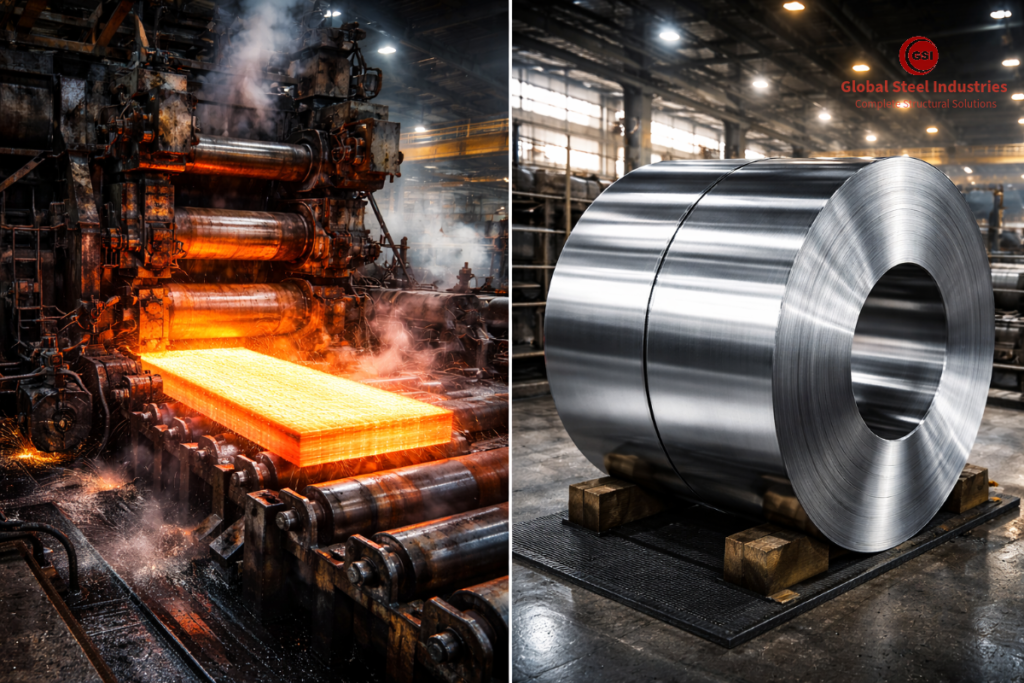
- The Hot Rolling Process
Hot rolling involves processing steel at temperatures above its recrystallization point — typically above 1700°F (926°C). At these temperatures, steel is highly malleable and can be rolled into sheets, plates, coils, angles, channels, and beams. As the steel cools, it contracts slightly, resulting in less precise dimensional tolerances. The surface develops a characteristic blue-grey scale (mill scale) from oxidation during cooling.
- The Cold Rolling Process
Cold rolling takes hot rolled steel and processes it further at room temperature through rolling mills. This work-hardening process increases the steel’s strength and hardness while achieving tighter dimensional tolerances and a smoother, brighter surface finish. Cold rolled steel is typically available in thinner gauges (under 3mm) and is used where surface quality and precision dimensions are critical.
- Key Differences at a Glance
Surface Finish: Hot rolled has a rough, scaled surface; cold rolled is smooth and bright. Dimensional Tolerance: Cold rolled is significantly more precise. Strength: Cold rolled is stronger and harder due to work hardening. Ductility: Hot rolled is more ductile and easier to form. Cost: Hot rolled is more economical; cold rolled costs more due to additional processing. Thickness Range: Hot rolled up to 100mm+; cold rolled typically 0.3–3mm.
- Applications of Hot Rolled Steel
Hot rolled steel is used where surface finish is not critical and dimensional tolerances can be relaxed. Key applications include structural beams, columns, and angles in construction, railway tracks and wheels, agricultural equipment frames, ship building and offshore structures, general fabrication and manufacturing, and reinforcing bars (rebars) for concrete.
- Applications of Cold Rolled Steel
Cold rolled steel is preferred in applications demanding precision and aesthetics. It is widely used in automotive body panels and exposed components, home appliances (washing machines, refrigerators), metal furniture and cabinets, electrical enclosures and panels, precision tubing and pipes, and stamped and pressed components. The superior surface finish makes it ideal for painting, powder coating, and electroplating.
- Which Should You Specify?
Specify hot rolled steel when cost efficiency matters more than surface quality, the application involves heavy structural loads, welding and forming are primary fabrication methods, and the product will be painted, coated, or embedded in concrete. Specify cold rolled steel when tight dimensional tolerances are required, the surface will be visible or decorative, stamping or forming precision is critical, and higher strength-to-thickness ratios are needed.
- Conclusion
Hot rolled and cold rolled steel are both essential to modern industry — the choice between them should be driven by your application’s requirements for surface finish, dimensional precision, strength, and budget. Global Steel Industries supplies both hot rolled and cold rolled steel in coils, sheets, and plates across a wide range of grades and specifications. Reach out to our sales team for product availability and pricing.
click here
Ready to source premium steel? Contact Global Steel Industries at globalsteelind.com or call 9324799893 / 9920397998