The Role of Steel in Data Centre Construction
The digital economy runs on data centres — massive facilities housing the server infrastructure that powers cloud computing, artificial intelligence, financial transactions, and global communication. As data centre construction accelerates worldwide, driven by artificial intelligence workloads and cloud adoption, structural steel plays an indispensable role in every aspect of these precision-built facilities. From the structural frame of the building itself to the raised access floors, equipment racks, cooling systems, and power infrastructure within, steel is present at every level. Global Steel Industries supplies structural steel, hollow sections, and flat products to data centre developers and contractors.
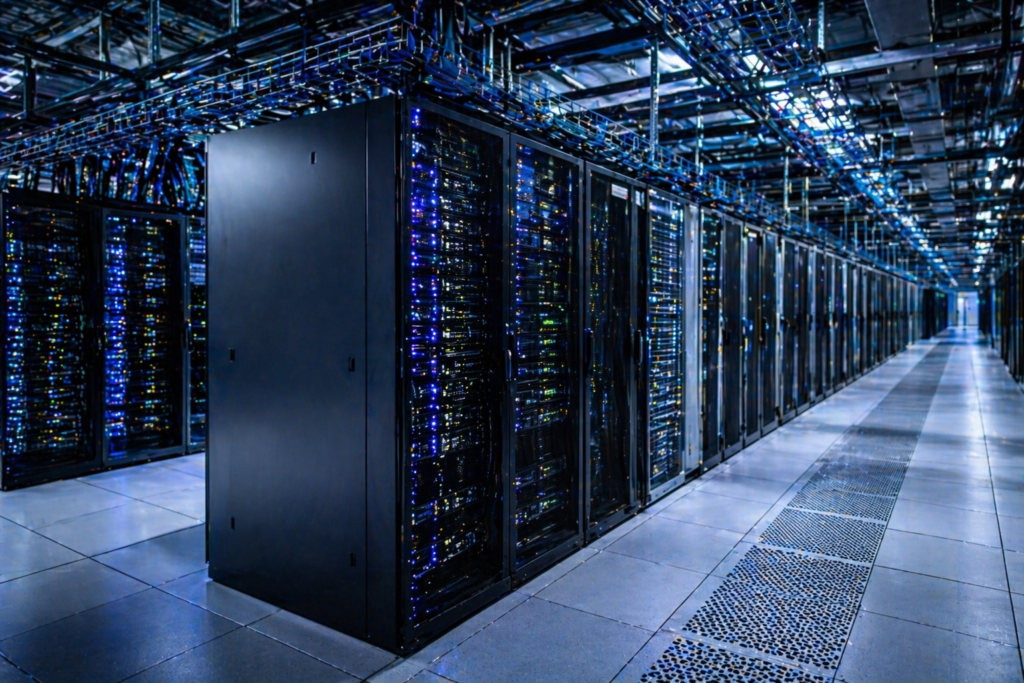
- Structural Steel Framing for Data Centres
Modern hyperscale data centres are purpose-designed buildings that must accommodate extreme floor loading from server racks, precise temperature and humidity control, and multiple redundant mechanical and electrical systems. Structural steel framing is the preferred construction method, offering speed of erection, design flexibility, and the ability to accommodate heavy equipment loads without the column spacing constraints of concrete frame construction.
Universal columns and beams in Grade S355 or equivalent high-tensile grades form the primary structure. Composite floors, combining steel decking with a concrete topping slab, provide the slab-to-slab heights required for under-floor plenum or overhead distribution systems. Pre-engineered steel building systems are increasingly specified for data centre shell and core construction due to their rapid delivery and erection timescales.
- Raised Access Floors and Cable Management
Raised access floors — elevated floor systems supported on adjustable steel pedestals — are a signature feature of data centre design. The space beneath the raised floor serves as a pressurized air plenum for cool air delivery to server aisles. Raised floor panels are typically 600mm square, constructed from high-density particleboard or calcium sulphate cores with a steel sheet encapsulation, supported on galvanized steel pedestals and stringer frames.
Overhead cable management systems, used in hot-aisle containment data centre designs, employ ladder-type cable trays and cable baskets fabricated from galvanized steel. The corrosion-resistant zinc coating is essential in the high-humidity environments created by precision cooling systems. Load ratings for cable trays must accommodate increasingly heavy fibre optic and power cable bundles as server density continues to increase.
- Server Racks and Equipment Supports
Server racks — the standard 19-inch equipment enclosures that house servers, storage arrays, and networking equipment — are steel fabrications that must withstand static loads up to several hundred kilograms while maintaining precise dimensional tolerances for equipment alignment. Cold-rolled steel sheet in Grade 304 stainless or electro-galvanized finish is the standard construction material, providing corrosion resistance in the precision-controlled data centre environment.
Power distribution units (PDUs), uninterruptible power supplies (UPS), and battery energy storage systems require heavy-duty steel support structures designed to accommodate equipment weights and seismic requirements in earthquake-prone regions. Transformer skids and switchgear support frames use structural sections and plates in Grade S275 or S355.
- Cooling Infrastructure Steel Requirements
Data centre cooling systems — including Computer Room Air Conditioning (CRAC) units, Computer Room Air Handlers (CRAH), chillers, cooling towers, and dry coolers — all incorporate significant quantities of steel in their frames, heat exchanger structures, and
support systems. Chilled water pipework for precision cooling systems is typically specified in ASTM A106 or equivalent carbon steel pipe with appropriate insulation to prevent condensation.
Cooling tower structures are fabricated from galvanized or stainless steel to resist the combination of moisture, biological activity, and treatment chemicals present in cooling water systems. Generator skids for backup power — an absolute requirement in data centre design — use heavy structural sections capable of supporting diesel generators rated from 1 MW to 3 MW for large hyperscale applications.
- Conclusion
Data centre construction is one of the fastest-growing sectors driving structural and specialty steel demand globally. Global Steel Industries supplies the full range of steel products required by data centre developers and contractors. Contact our team at globalsteelind.com to discuss your project requirements.
Ready to source premium steel? Contact Global Steel Industries at globalsteelind.com or call 9324799893 / 9920397998