Forged Steel vs Cast Steel: Understanding the Manufacturing Difference
- Two Fundamental Shaping Processes
When steel must be shaped into a complex component — a valve body, a gear blank, a flange, or a structural connector — engineers choose between two fundamentally different manufacturing routes: forging and casting. Each process imparts distinct characteristics to the finished component’s microstructure, mechanical properties, and suitability for different service conditions. Understanding these differences is essential for making sound material and manufacturing decisions
- The Forging Process and Its Microstructural Benefits
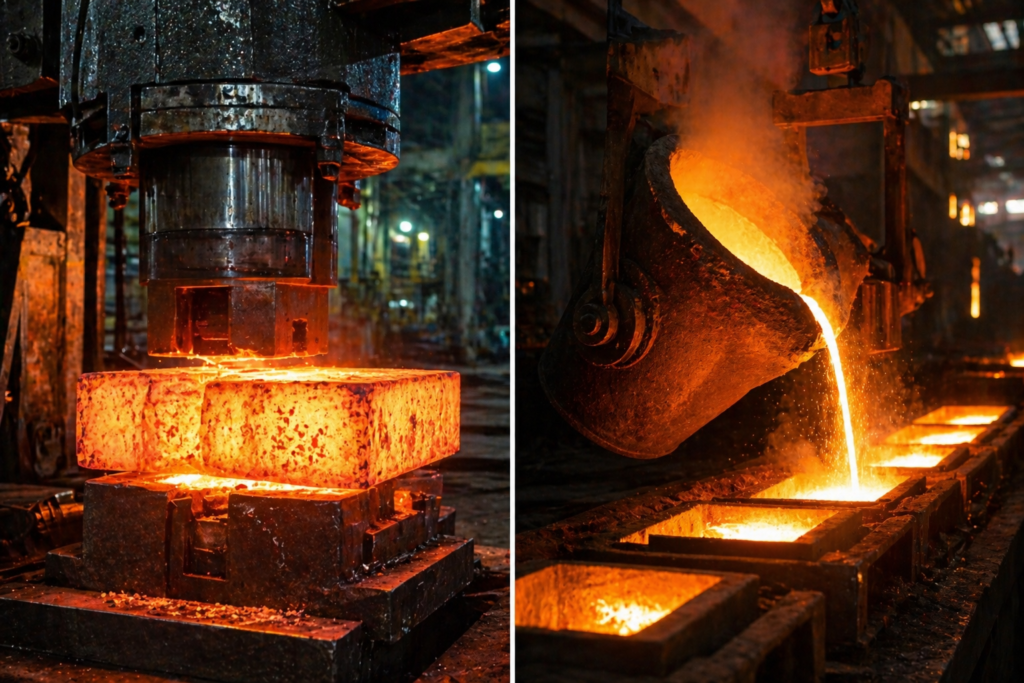
Forging involves plastically deforming a heated steel billet or ingot by compressive forces — using hammers, presses, or rollers — to shape it into the desired form while above the recrystallisation temperature. This hot working breaks up the as-cast dendritic solidification structure of the steel ingot, closes shrinkage porosity and voids, aligns and elongates non-metallic inclusions in the working direction, and refines the grain size through recrystallisation.
The result is a forging with directional grain flow following the component geometry — fibrous texture that improves tensile strength, fatigue resistance, and impact toughness compared to cast steel with the same chemical composition. For critical stressed components including crankshafts, connecting rods, turbine discs, and pressure vessel nozzles, the microstructural advantages of forging translate directly into improved reliability and service life.
- Casting: Design Freedom and Geometry Complexity
Casting involves melting steel and pouring it into a shaped mould, where it solidifies to the finished or near-finished component shape. Casting is uniquely capable of producing extremely complex internal and external geometries — hollow passages, undercuts, complex curves, and integrated features that would be prohibitively expensive or impossible to forge or machine.
Steel casting grades for pressure-retaining applications include ASTM A216 WCB (carbon steel, used for the majority of steel valve and fitting castings in ambient to moderately elevated temperature service), A217 WC6, WC9 (low-alloy steel for high-temperature service), and A351 CF8M (cast 316 stainless steel for corrosive service). Casting soundness — freedom from shrinkage cavities, porosity, and cracks — is assured through radiographic and ultrasonic examination per ASME B16.34 or equivalent standards.
- Mechanical Properties: Forged vs Cast
For equivalent chemical composition and heat treatment, forgings generally develop superior mechanical properties compared to castings. Tensile strength, yield strength, impact energy, and fatigue life are all typically 20–40% higher in wrought (forged or rolled) steel than in cast steel. This advantage is greatest in the short-transverse direction relative to the grain flow.
However, modern steel casting practice — with careful mould design, risering to minimise shrinkage, degassing, and rigorous non-destructive testing — produces castings with mechanical properties adequate for most industrial applications. The choice between forging and casting therefore depends not just on mechanical property targets but on component geometry, production volume, lead time, and cost.
- Standards for Forgings and Castings
Forgings for pressure vessels and piping are governed by ASTM A105 (carbon steel flanges, fittings, and valves for ambient and high-temperature service), ASTM A182 (alloy and stainless steel flanges and fittings), and ASTM A350 (carbon and low-alloy steel flanges for low-temperature service). Steel castings for pressure applications conform to ASTM A216, A217, A351, and A352 depending on material grade and service temperature.
Global Steel Industries supplies both forged and cast steel components — flanges, fittings, valve bodies, and pressure vessel nozzles — with full documentation including material test certificates, heat treatment records, and non-destructive examination reports.
- Conclusion
The choice between forged and cast steel depends on your application’s geometry, mechanical property requirements, and production economics. Global Steel Industries can supply both — with expert guidance on which manufacturing route best serves your specific needs. Contact us at globalsteelind
.com.
Ready to source premium steel? Contact Global Steel Industries at globalsteelind.com or call 9324799893 / 9920397998