Alloy Steel Plates: Properties, Grades & Critical Applications
When standard carbon steel cannot meet the demands of extreme service environments, alloy steel plates step in as the solution. By incorporating controlled amounts of alloying elements such as chromium, molybdenum, nickel, vanadium, and manganese, metallurgists can design steels with precisely tailored properties for the most demanding industrial applications. Global Steel Industries supplies a comprehensive range of alloy steel plates meeting the requirements of the oil and gas, power generation, and petrochemical industries.
Alloy steel is defined as steel containing deliberately added alloying elements beyond carbon and minimal quantities of manganese, silicon, and copper. These additions modify the steel’s microstructure, hardenability, mechanical properties, and resistance to specific degradation mechanisms. The careful selection and balancing of alloying elements allow metallurgists to achieve combinations of strength, toughness, creep resistance, and corrosion resistance that cannot be attained with carbon steel alone.
Chromium and molybdenum are particularly important alloying elements for high-temperature service, enhancing the steel’s resistance to oxidation and creep. Nickel additions improve toughness at sub-zero temperatures, critical for cryogenic applications. Vanadium and niobium contribute to grain refinement and increased strength through precipitation hardening.
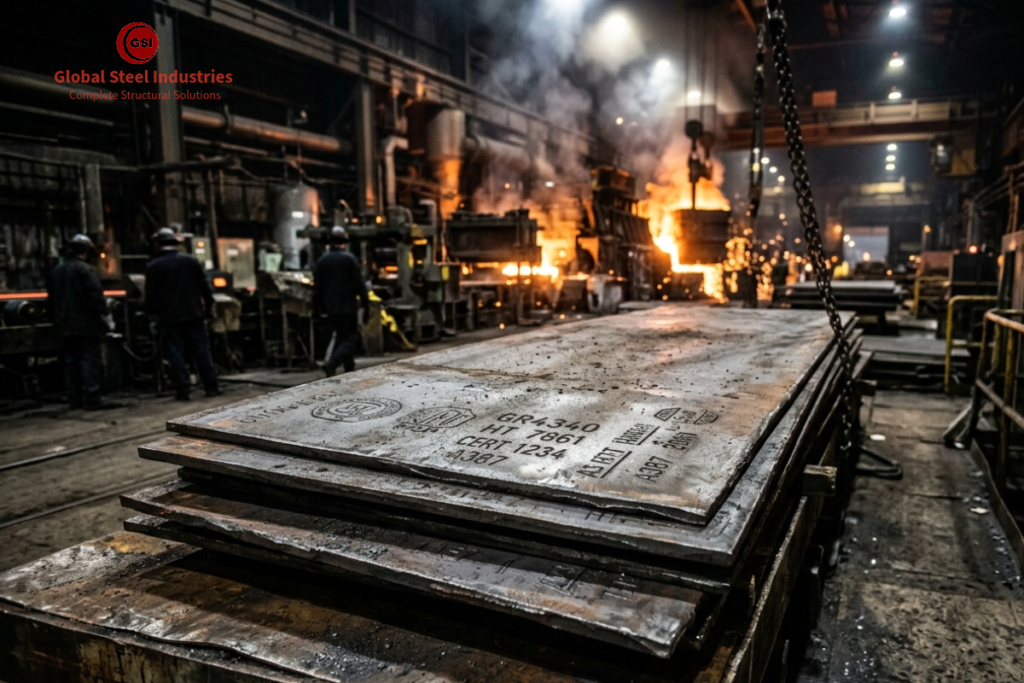
ASTM A387 is the primary standard governing alloy steel plates for pressure vessels operating at elevated temperatures. Grade 11 (Cr-Mo), Grade 22 (Cr-Mo), and Grade 91 (Cr-Mo-V) represent the most widely used compositions, each offering progressively higher temperature capability and creep resistance. Grade 91 steel, with its high chromium and molybdenum content plus vanadium additions, is the standard of choice for the most thermally demanding power generation applications.
ASTM A517 grades are high-yield-strength quenched and tempered alloy plates used in pressure vessels requiring exceptional strength-to-weight ratios. ASTM A514 provides weldable
high-strength structural plate for applications such as crane booms, lifting equipment, and heavily loaded structural members.
One of the primary drivers for specifying alloy steel plates is their superior performance in high-temperature service. At elevated temperatures, steel undergoes creep — a time-dependent deformation under sustained stress that ultimately leads to failure if not properly accounted for in design. Chromium-molybdenum alloy steels have been developed and refined over decades to maximize creep rupture strength while maintaining weldability and fabricability.
Power plant boilers, superheater headers, steam lines, and turbine casings routinely operate at temperatures where only alloy steel plates can provide the required service life. The material selection must be matched to both the maximum operating temperature and the required design life, which may exceed 30 years in power generation applications
In petrochemical refineries and hydrogen processing facilities, equipment constructed from regular carbon steel can suffer hydrogen-induced cracking (HIC) and sulfide stress cracking (SSC) when exposed to wet hydrogen sulfide environments. Alloy steel plates used in these services must comply with NACE MR0175/ISO 15156 requirements for hardness limits and microstructural cleanliness.
Global Steel Industries supplies alloy steel plates tested and certified for hydrogen service applications, with full documentation demonstrating compliance with NACE requirements. Our strong relationships with qualified mills ensure consistent access to materials meeting these stringent specifications.
Alloy steel plates generally require more careful fabrication procedures than carbon steel. Preheat requirements increase with alloy content and plate thickness to prevent hydrogen cracking in the heat-affected zone. Post-weld heat treatment is typically mandatory for most alloy steel pressure vessel fabrication to relieve residual stresses and temper the microstructure in the weld and heat-affected zone.
Global Steel Industries can provide detailed recommendations on welding procedures, preheat temperatures, and PWHT parameters for every alloy steel grade we supply, supporting your fabrication team in achieving compliant, high-quality welds.
Alloy steel plates are the engineering material of choice for the most demanding high-temperature, high-pressure, and corrosive service environments in the industrial world. Global Steel Industries has the product knowledge, quality systems, and supply capability to meet your alloy steel requirements. Contact us at globalsteelind.com for specifications and a project-specific quote. click here
Ready to source premium steel? Contact Global Steel Industries at globalsteelind.com or call 9324799893 / 9920397998