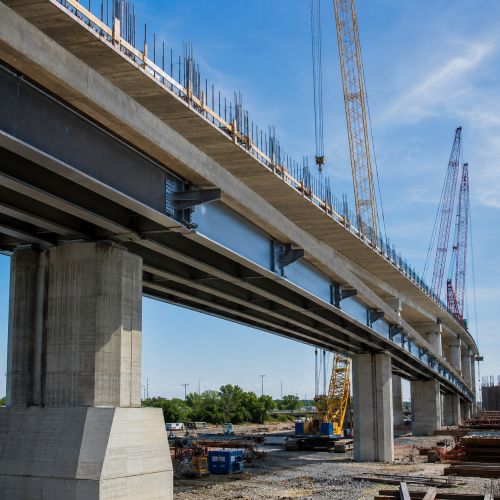
Steel in Bridges: Design Philosophies, Material Grades & Corrosion Management
The combination of high strength, high stiffness, excellent toughness, and weldability makes steel the engineer’s material of choice for long-span and medium-span bridge construction. Steel’s high strength-to-weight ratio enables lighter superstructures that reduce the loads on foundations a significant advantage in soft soil conditions. Steel bridges can be fabricated offsite and erected quickly with minimal road closures, meeting the project programme requirements of congested urban infrastructure upgrades. Global Steel Industries supplies bridge-quality structural steel to fabricators and contractors serving India’s rapidly expanding road and rail infrastructure
Bridge structural steel must combine high yield strength for efficient section design with excellent fracture toughness at the lowest expected service temperature — brittle fracture of a bridge tension member is catastrophic and irreversible. European bridges use S355J2+N or S355K2+N (with Charpy testing at −20°C) for primary structural members, with S460M/ML for weight-critical applications where the strength premium justifies the higher material cost.
For bridges in the USA and countries following AASHTO standards, Grades 36, 50W (weathering), HPS 70W, and HPS 100W are the standard structural bridge grades. HPS (High Performance Steel) grades are produced with controlled microalloying that delivers high Charpy energy (40 J at −23°C minimum) ensuring fracture-safe performance over the 75-100 year design life.
A Fracture Critical Member (FCM) in bridge terminology is a steel tension component whose failure would cause the collapse of the bridge or a significant portion of it. Two-girder and box-girder bridges with non-redundant tension flanges contain FCMs — if a single member fractures, there is no alternative load path and the structure falls. The consequences drive extremely stringent requirements on FCM steel quality.
FCM fabrication under AASHTO includes material testing at the plate level rather than the heat level; supplementary CVN testing at −34°C (Zone 3) with guaranteed minimum values; more restrictive welding procedures with lower heat input; 100% non-destructive testing of all welds; and documentation and traceability requirements beyond those for non-FCM steel. These requirements add cost but provide the assurance that catastrophic brittle failure will not occur in service.
Weathering steel (ASTM A588, EN Grade S355J0WP/S355J2WP) alloys small quantities of copper, chromium, phosphorus, and nickel into the steel to produce a dense, adherent rust patina that acts as a corrosion barrier rather than an ongoing corrosion product. After an initial weathering period of 2–5 years, the patina stabilises and the steel corrodes at a rate of only 1–3 μm per year — compared to 75–150 μm per year for unprotected carbon steel.
Weathering steel bridges eliminate the need for repainting over the bridge design life, saving millions of rupees in maintenance cost for a typical medium-span bridge. Design requirements include free-draining details to prevent standing water that prevents the patina from forming, adequate air circulation around all members, and avoidance of chloride contamination that can destabilise the patina in coastal environments.
Bridge steelwork fabrication is subject to more stringent quality requirements than standard structural fabrication. All butt welds in primary structural members require radiographic or ultrasonic examination. Web-to-flange fillet welds in girders require magnetic particle inspection. Camber, sweep, and dimensional tolerances on fabricated girders are tighter than for general structural work. High-strength friction-grip bolted connections — the standard for site-bolted splices — require proper surface preparation, certified bolt assemblies, and torque verification.
Global Steel Industries supplies certified bridge plate in S355, S460, and weathering grades with the documentation and traceability required for bridge project quality plans.
Bridge steel combines structural efficiency with longevity requirements that demand the highest standards of material quality and fabrication control. Global Steel Industries is an experienced supplier to India’s bridge construction industry. Contact us at globalsteelind.com.
Ready to source premium steel? Contact Global Steel Industries at globalsteelind.com or call 9324799893 / 9920397998