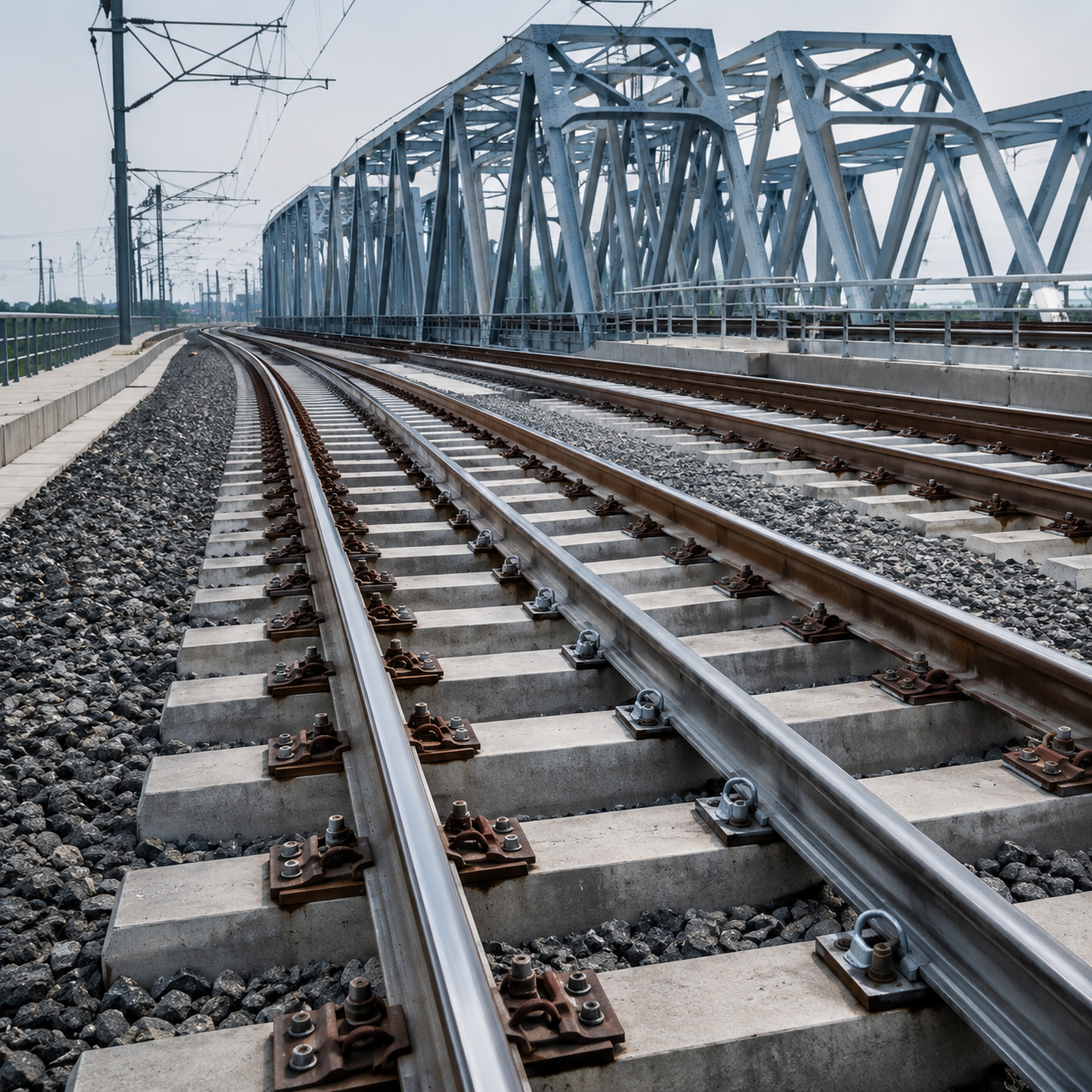
Steel in Railway Infrastructure: Rails, Sleepers & Bridge Structures
- Steel as the Foundation of Rail Transport
Railway transport — one of the most energy-efficient and carbon-effective modes of mass transportation — is fundamentally dependent on steel. Rails guide and support trains. Steel bridge structures carry rail loads across rivers, valleys, and urban infrastructure. Steel in locomotive and wagon fabrication enables the structural integrity of rolling stock. Track fastening hardware, turnouts, crossings, and maintenance equipment all rely on steel grades engineered for the specific demands of railway service. As India and the world invest in railway network expansion and modernisation, quality railway steel supply is a priority for Global Steel Industries.
- Rail Grades and Standards
Railway rails must simultaneously support the weight of trains, guide wheel flanges, resist fatigue from millions of wheel passages, and resist wear from wheel-rail contact without fracture. Rail steel is a high-carbon pearlitic steel — typically 0.65–0.82% carbon — with carefully controlled manganese and silicon content that provides high hardness and wear resistance while maintaining adequate toughness to resist rail foot fracture under dynamic wheel loads.
EN 13674 classifies rails by minimum hardness at the rail head: Grade 260 (260 HBW), Grade 320Cr (chromium-alloyed for improved wear and rolling contact fatigue resistance), Grade 370CrHT (heat-treated, 370 HBW head hardness, used on high-speed lines), and premium grade hypereutectoid rails for very high traffic corridors. Indian Railways specifies rails to IS 3443 — 60 kg/m UIC 60 rail profile is now standard for new main line construction.
- Fish Plates, Sleeper Plates and Track Fittings
Fish plates (joint bars) connect adjacent rail ends at bolted joints — now largely eliminated on main lines in favour of continuously welded rail (CWR), but still used at switches, crossings, and in lower-traffic branch line sections. Fish plates are fabricated from medium-carbon steel (0.25–0.45% C) conforming to IS 1175 or equivalent, heat-treated to develop sufficient hardness to resist deformation under repeated bolting and wheel impact loading.
Sleeper plates, tie plates, and base plates protect the sleeper from rail foot wear at the rail-sleeper contact, distribute load, and provide the correct cant angle for the rail head. They are fabricated from medium-carbon or high-tensile steel conforming to railway authority specifications. Spring steel clips (e.g., Pandrol, Vossloh) that retain the rail against the base plate are manufactured from 60Si2Mn spring steel hardened and tempered to HRC 42–47.
- Switch and Crossing Components
Railway turnouts — switches (points) and crossings that allow trains to change between tracks — are among the most technically demanding steel fabrications in railway infrastructure. Movable switch blades must flex repeatably over millions of operations without fatigue cracking; crossings (frogs) must resist the severe impact loading of flanged wheels passing over the crossing gap at high speed.
Switch blades are fabricated from high-manganese or special grade rail steel that combines the hardness needed for wear resistance with the flexibility needed for movement. Manganese steel crossings (12–14% Mn Hadfield’s steel) work-harden under wheel impact, developing surface hardness of 400+ HBW in service while retaining the exceptional toughness that prevents fracture under dynamic loading.
- Steel Railway Bridges
Railway bridges impose substantially higher loads than highway bridges — not only due to the concentrated wheel loads of heavy freight trains but also the dynamic impact factor, braking and tractive forces, and centrifugal forces on curved bridges. Railway bridge girders are designed to tighter deflection limits than highway bridges, since excessive deflection would cause unacceptable rail geometry distortion and risk derailment.
Welded plate girder railway bridges use Grade S355J2 or Grade S460M plates with full-penetration web-to-flange welds qualified to EN 1090-2 execution class EXC3. High-strength friction grip (HSFG) bolted connections are standard for field splices in railway bridge flanges. Global Steel Industries supplies structural plates and sections to railway bridge specification.
- Conclusion
Railway infrastructure demands steel grades and quality levels unique to this safety-critical application. Global Steel Industries supplies rails, structural sections, and bridge plate to railway specification. Contact us at globalsteelind.com for railway project steel requirements.
Ready to source premium steel? Contact Global Steel Industries at globalsteelind.com or call 9324799893 / 9920397998