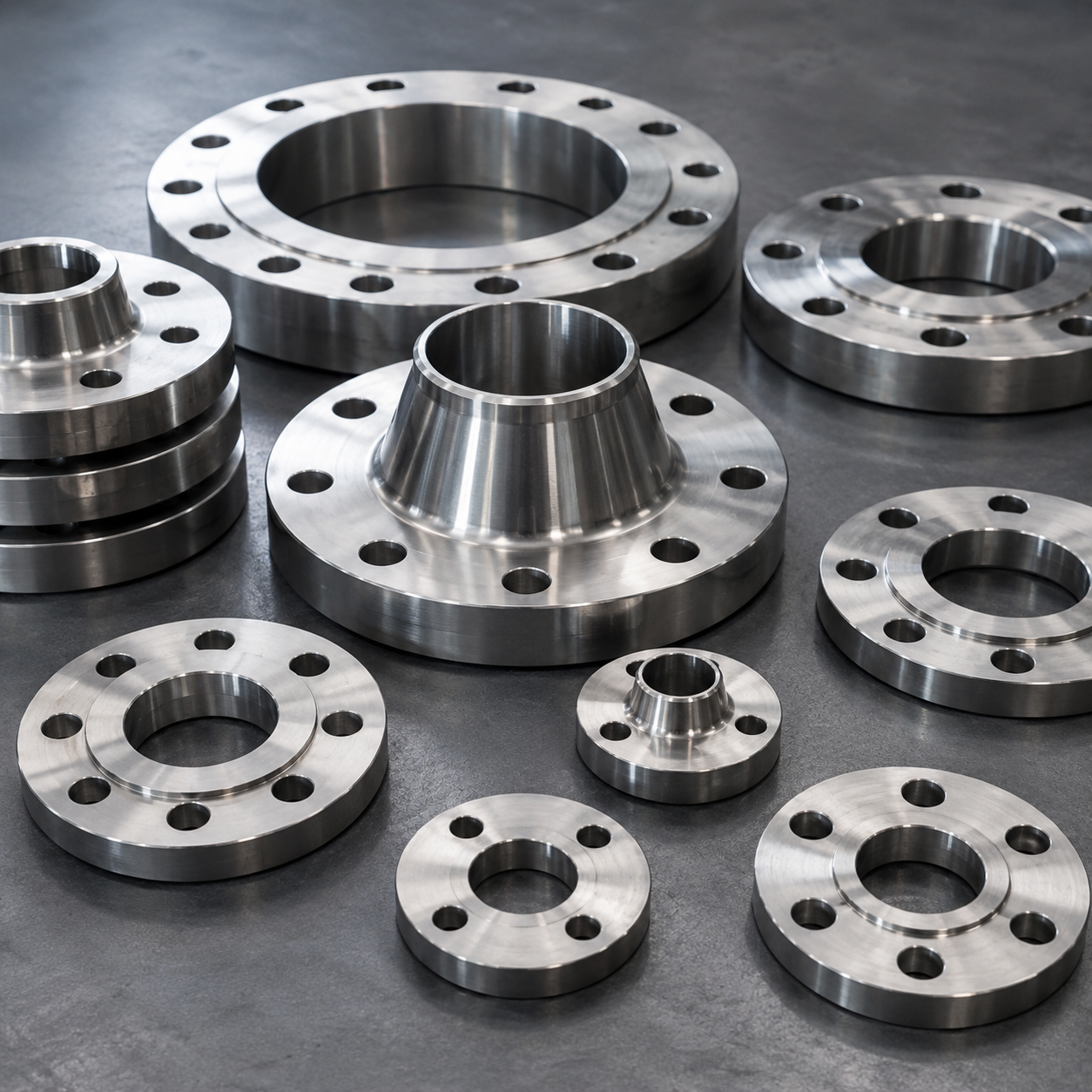
Pipe Flanges: Types, Pressure Classes & Correct Specification
- The Role of Flanges in Piping Systems
Pipe flanges create bolted, gasketed connections between pipes, valves, pumps, and other piping system components that must be capable of disassembly for maintenance, inspection, or modification. A properly selected, correctly installed flange connection is a reliable, leak-free joint capable of handling the full design pressure and temperature of the piping system. An improperly specified flange — wrong pressure class, wrong material, or wrong facing — is a potential source of hazardous leakage. Global Steel Industries supplies carbon steel, alloy steel, and stainless steel flanges to exacting international standards
- Flange Types: WN, SO, BL, LJ and More
Weld Neck (WN) flanges have a long tapered hub that is butt-welded to the pipe, providing a gradual stress transition from flange to pipe wall — making them the preferred choice for high-pressure, high-temperature, and cyclic service where stress concentration at the joint must be minimised. Slip-On (SO) flanges slide over the pipe end and are fillet-welded inside and outside — simpler to align than weld neck flanges but less suitable for severe service due to the stress concentration at the inside fillet weld.
Blind (BL) flanges close the end of a pipe, nozzle, or valve, providing a pressure-retaining closure. They are also used temporarily during pressure testing. Lap Joint (LJ) flanges are used with stub ends, allowing the flange to rotate around the pipe stub — useful for alloy stub ends with carbon steel flanges in corrosive service, or for alignment of bolt holes. Socket Weld (SW) and Threaded (Th) flanges serve small-bore, high-pressure piping similar to their fitting counterparts.
- ASME B16.5 Pressure-Temperature Classes
ASME B16.5 defines the seven pressure classes for flanges from Class 150 to Class 2500, each with a pressure-temperature rating table that specifies the maximum allowable working pressure at temperatures from −29°C to 538°C for each material group. Class 150 (approximately 19–20 bar at ambient temperature for carbon steel) is the standard for low-pressure utility service. Class 300 (50 bar ambient) for moderate-pressure process service. Classes 600, 900, 1500, and 2500 cover progressively higher-pressure applications.
The material group determines the actual pressure-temperature rating — Group 1.1 (A105, WCB) is lower-rated than Group 2.1 (F11, WC6) at elevated temperatures. Specifying the flange class without specifying the material group leaves the pressure-temperature rating indeterminate — both must be stated in the piping specification
- Facing Types and Gasket Selection
Flange facing — the surface that contacts the gasket — comes in several standard types for different service conditions. Raised Face (RF) is the standard for most process piping, with the gasket seating on a small raised annular surface that concentrates bolt load on the gasket. Full Face (FF) is used with flat-face flanges in low-pressure ductile iron or glass-lined equipment connections. Ring Type Joint (RTJ) uses a metallic ring gasket in a machined groove, providing a metal-to-metal seal suitable for the highest pressures and temperatures.
Gasket selection must be compatible with both the flange facing and the piped fluid. Spiral wound gaskets with graphite or PTFE filler are the standard for process piping. Solid metal ring gaskets in soft iron, SS 316, or inconel serve extreme-pressure RTJ connections. Incorrect gasket material selection is a leading cause of flange leakage in operating plants.
- Material Grades and Service Suitability
ASTM A105 is the standard material for carbon steel flanges in ambient-to-elevated temperature service. A182 F11 (1.25Cr-0.5Mo) and F22 (2.25Cr-1Mo) are the alloy steel grades for elevated temperature service in power plants and refineries. A182 F316L is the standard stainless steel flange grade for corrosive process service. A350 LF2 is the low-temperature carbon steel flange grade with Charpy impact testing at −46°C.
Global Steel Industries supplies flanges in all standard grades from Class 150 to Class 2500, in sizes from DN15 to DN600 and beyond, with complete EN 10204 3.1 material certifications and dimensional inspection reports.
- Conclusion
Correct flange specification and quality supply are fundamental to piping system integrity. Global Steel Industries supplies the full range of flanges for every service condition and standard. Contact our team at globalsteelind.com for specifications and competitive quotations.
Ready to source premium steel? Contact Global Steel Industries at globalsteelind.com or call 9324799893 / 9920397998