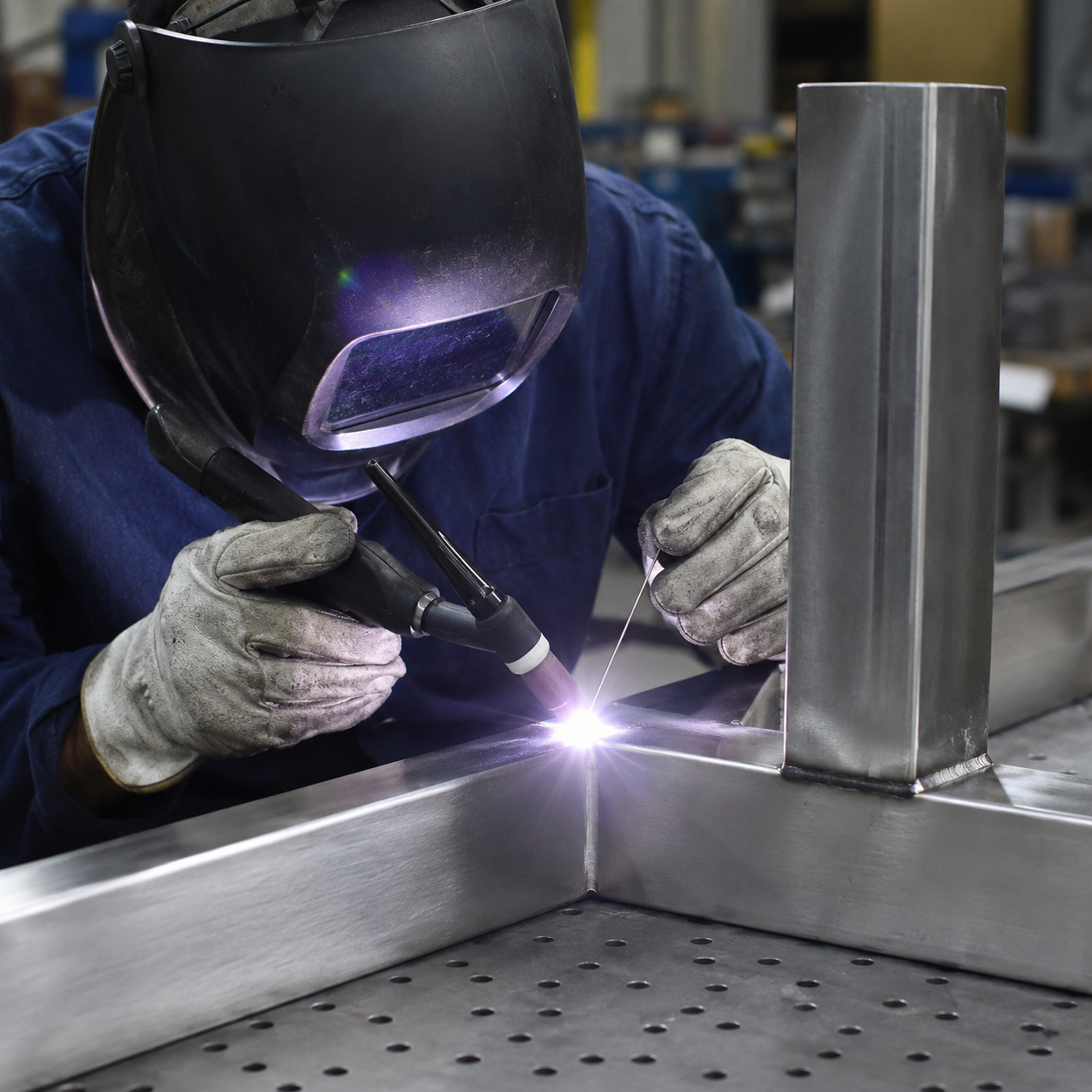
The Science of Steel Welding: Metallurgy, Heat Input & Joint Integrity
- Why Welding Metallurgy Matters
Welding joins steel components by fusion — locally melting both the base metal and filler material, allowing atomic bonding across the joint as the metal solidifies. But the thermal cycle of welding — rapid heating to above the melting point followed by rapid cooling — subjects the metal adjacent to the weld to conditions that fundamentally alter its microstructure. Understanding these metallurgical changes is essential for selecting weldable steel grades, specifying correct preheat and post-weld heat treatment, and achieving joints with the mechanical properties required for safe and reliable service.
- Dimensional Tolerances of Cold-Drawn Bars
The dimensional tolerances achievable by cold drawing depend on the bar diameter, the die design, and the precision of the drawing equipment. Cold-drawn round bars conforming to EN 10278 Class h9 or h11 (ISO tolerance designations) are standard for most precision machining supply. Grade h9 tolerances for a 30mm diameter bar are −0 / −0.052mm — tight enough to be used as ground journal fits in many applications without additional grinding.
For the tightest tolerance applications, ground and polished bar (produced by centreless grinding after cold drawing) achieves h6 tolerances of −0 / −0.013mm on a 30mm bar — approaching the accuracy of precision journal grinding. IS 9175 covers cold-finished steel bars produced in India, while ASTM A108 covers US cold-finished carbon steel bar standards.
- The Heat-Affected Zone (HAZ)
The Heat-Affected Zone is the region of base metal adjacent to the weld fusion line that has not melted but has been heated sufficiently to alter its microstructure. In the portion immediately adjacent to the fusion line (the coarse-grained HAZ), temperatures reach 1100°C+ — above the austenite grain coarsening temperature — producing a zone of enlarged austenitic grains that transform on cooling to coarse martensite or bainite with reduced toughness.
Farther from the fusion line, lower peak temperatures produce fine-grained, intercritically heated, and sub-critically heated zones that may be softer or harder than the base metal depending on the original heat treatment condition. The coarse-grained HAZ is typically the weakest link in a weld — its potential for hydrogen-induced cold cracking and reduced impact toughness drives preheat and post-weld heat treatment requirements.
- Carbon Equivalent and Weldability
Carbon equivalent (CE) is an index that combines the effects of carbon and other alloying elements on the hardenability — and hence the weldability — of steel. The International Institute of Welding (IIW) formula, CE = C + Mn/6 + (Cr+Mo+V)/5 + (Ni+Cu)/15, is widely used to estimate preheat requirements and susceptibility to hydrogen cracking. As CE increases above approximately 0.40, the risk of cold cracking in the HAZ increases and minimum preheat temperature requirements rise.
Low CE steels (below 0.35) can be welded without preheat in most conditions. Medium CE steels (0.35–0.50) require moderate preheat, particularly in thick sections and in cold weather. High CE steels (above 0.50) require high preheat (150–250°C) and careful management of hydrogen in the welding consumable and procedure. This is why alloy steels, high-tensile grades, and some tool steels require specialized welding procedures.
- Hydrogen-Induced Cold Cracking
Hydrogen-induced cold cracking (HICC), also called delayed cracking or hydrogen embrittlement cracking, is the most common and dangerous weld defect in higher-strength steels. Atomic hydrogen from moisture in welding consumables or the atmosphere diffuses into the HAZ during welding and concentrates at stress concentrations — notches, inclusions, and grain boundaries — in hard martensite. Under residual weld stress, the hydrogen embrittles the martensite, causing cracks to form hours or days after welding is completed.
The three necessary conditions for HICC are: susceptible (hard martensitic) microstructure; hydrogen above a threshold concentration; and tensile stress above a critical level. Prevention requires selecting low-hydrogen welding processes (basic-coated electrodes, low-hydrogen wire, dry flux), applying adequate preheat to slow cooling and allow hydrogen to diffuse out, and using interpass temperature control to prevent rehardening between passes.
- Post-Weld Heat Treatment (PWHT)
Post-weld heat treatment at temperatures of 580–650°C for carbon and low-alloy steels provides several benefits: it tempers hard martensite in the HAZ, restoring toughness; it relieves residual stresses from the weld thermal cycle; it allows any dissolved hydrogen to diffuse out; and for alloy steels, it may restore the mechanical properties required by the design code. PWHT is mandatory for pressure vessels above certain thickness thresholds under ASME VIII, EN 13445, and equivalent codes.
Global Steel Industries can advise on the weldability of any grade we supply, including recommended preheat temperatures, filler metal selection, and PWHT parameters based on steel chemistry and intended service.
- Conclusion
Weld quality is only as good as the metallurgical understanding behind the welding procedure. Global Steel Industries provides technical support on weldability for all steel grades we supply. Contact our team at globalsteelind.com for welding metallurgy guidance and material recommendations.
Ready to source premium steel? Contact Global Steel Industries at globalsteelind.com or call 9324799893 / 9920397998