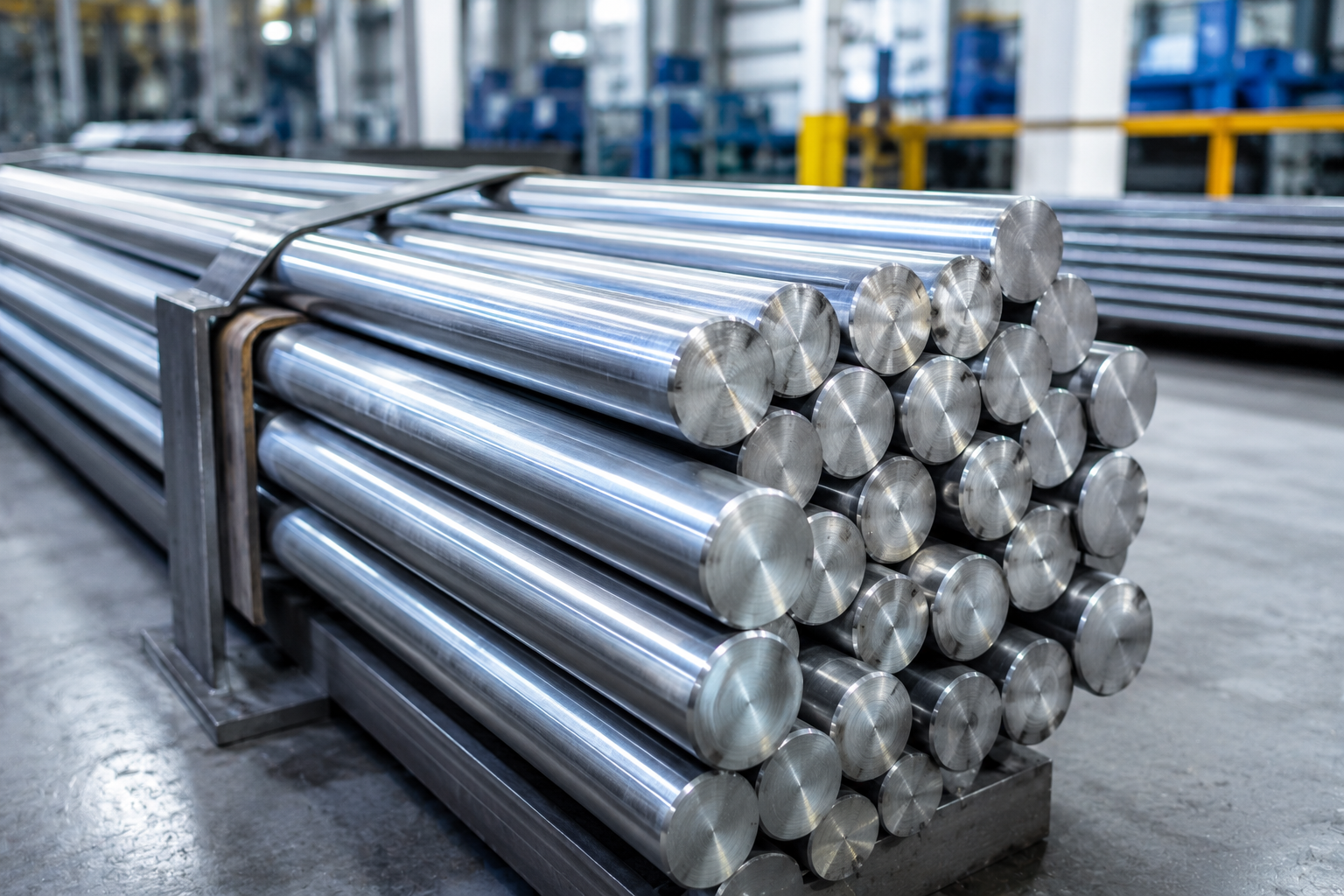
Cold-Drawn Steel Bars: Tolerances, Surface Finish & Precision Applications
Cold drawing is a precision metal working process in which a steel bar or rod is pulled through a tungsten carbide die at room temperature, reducing its diameter and simultaneously improving its dimensional accuracy, surface finish, and mechanical properties through work hardening. The process transforms hot-rolled bar stock — with its rough mill scale surface, relaxed dimensional tolerances, and variable straightness — into precision-ground-equivalent bar with tight tolerances, a bright surface, and higher strength.
For machining shops, precision component manufacturers, and automated bar-fed CNC machines, cold-drawn bar delivers significant advantages over hot-rolled stock: tighter tolerances reduce machining stock allowances; improved straightness reduces bar feed interruptions; the bright surface is free of mill scale that damages cutting tools; and higher yield strength can allow thinner sections in the finished component.
The dimensional tolerances achievable by cold drawing depend on the bar diameter, the die design, and the precision of the drawing equipment. Cold-drawn round bars conforming to EN 10278 Class h9 or h11 (ISO tolerance designations) are standard for most precision machining supply. Grade h9 tolerances for a 30mm diameter bar are −0 / −0.052mm — tight enough to be used as ground journal fits in many applications without additional grinding.
For the tightest tolerance applications, ground and polished bar (produced by centreless grinding after cold drawing) achieves h6 tolerances of −0 / −0.013mm on a 30mm bar — approaching the accuracy of precision journal grinding. IS 9175 covers cold-finished steel bars produced in India, while ASTM A108 covers US cold-finished carbon steel bar standards.
Cold drawing work-hardens the steel, increasing yield strength and tensile strength at the expense of ductility and toughness. A Grade S275 (275 MPa minimum yield) hot-rolled bar may achieve 340–380 MPa yield after cold drawing, allowing component designers to use smaller cross-sections for the same load capacity. Machinability also improves with the lower ductility of cold-drawn carbon steel — chips break more cleanly and surface finish after turning is improved.
However, the residual stresses introduced by cold drawing must be considered in applications involving high-precision grinding or machining. Deep grinding cuts or aggressive material removal can release residual stresses and cause dimensional distortion. For parts requiring extreme dimensional stability, stress-relief annealing after rough machining — before finish grinding — is recommended practice.
Free-machining steel grades incorporate sulphur (and sometimes lead or bismuth) additions that create discontinuities in the steel matrix — sulphide inclusions that promote chip breaking and reduce cutting forces in high-speed automatic machining operations. Grade 230M07 (BS designation, 0.3% S) and AISI 12L14 (0.3% S, 0.25% Pb) are widely used in automotive and general engineering for screw machine production of small complex components.
The machinability improvements from free-machining grades can reduce cycle times by 30–50% compared to standard grades — a significant economic advantage in high-volume production. However, the sulphide inclusions that improve machinability reduce transverse ductility and fatigue life, making free-machining grades unsuitable for heavily loaded structural parts or components with through-thickness loading.
Cold-drawn bars are the standard raw material for automated CNC turning centres producing fasteners, shafts, valve stems, hydraulic fittings, and precision mechanical components. The consistent diameter and surface quality allow bar-fed lathes to run with minimal operator intervention at high productivity. Cold-drawn hexagonal bars are essential for nut and bolt manufacturing, aligning naturally with the hexagonal profile of fastener heads.
Global Steel Industries supplies cold-drawn round, hexagonal, flat, and square bars in carbon steel, alloy steel, and stainless steel grades with dimensional certifications conforming to EN 10278, ASTM A108, and IS 9175 as required by customer specifications.
Cold-drawn steel bars deliver precision, surface quality, and mechanical performance advantages that hot-rolled stock cannot match. Global Steel Industries supplies cold-drawn bars in a comprehensive range of grades, sizes, and tolerances. Contact us at globalsteelind.com for product availability and pricing.
Ready to source premium steel? Contact Global Steel Industries at globalsteelind.com or call 9324799893 / 9920397998