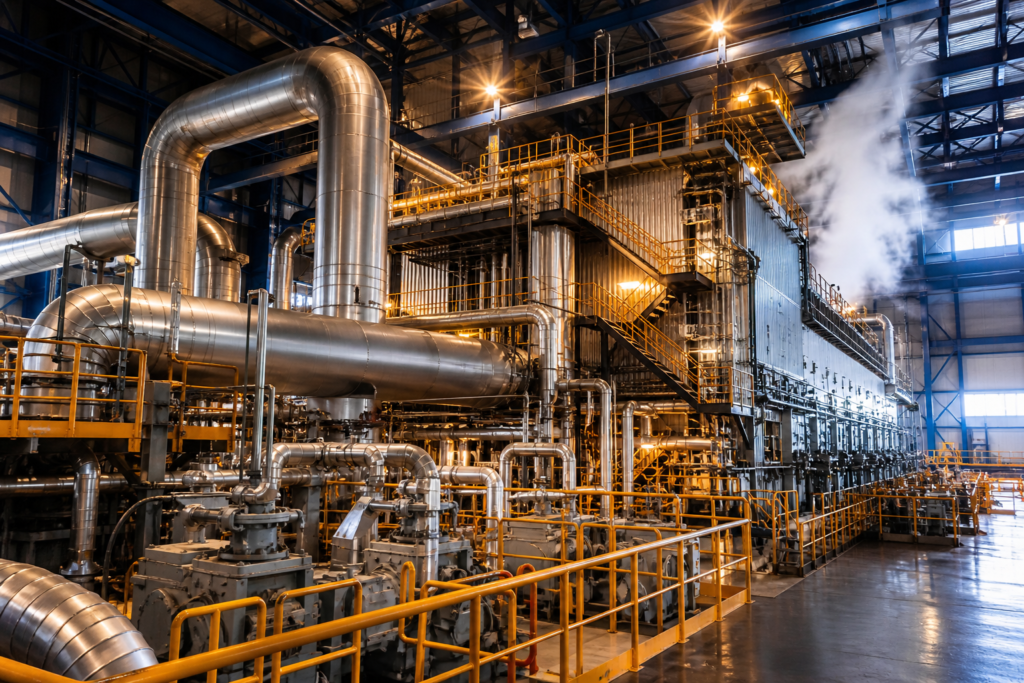
Steel in Power Generation: Coal Plants, Gas Turbines & Nuclear Applications
Every form of conventional power generation — coal, gas, oil, and nuclear — depends on steel for its primary plant and infrastructure. Boiler pressure parts operating at supercritical conditions, gas turbine compressor casings, steam turbine casings, condenser shells, and the structural frameworks supporting all these components are fabricated from a carefully selected range of carbon, alloy, and stainless steel grades. As global power capacity expands to meet energy demand and ageing plant is replaced, the demand for power plant grade steel continues to grow. Global Steel Industries is an experienced supplier to the power generation sector.
Modern high-efficiency power boilers operate at steam temperatures of 580–620°C and pressures of 250–300 bar in ultra-supercritical (USC) configurations. These conditions demand alloy steels with exceptional creep strength — the ability to resist slow plastic deformation under sustained load at elevated temperature. P91 (9Cr-1Mo-V-Nb, ASTM A335 Grade P91) is the current standard for main steam and hot reheat piping in USC boilers, with a hundred-thousand-hour creep rupture strength that is two to three times that of older P22 grade.
Superheater and reheater tube circuits, which form the hottest parts of the boiler, use T91 tubes (ASTM SA213 T91) for the primary superheat surface, with T92 (9Cr-1.8W-V-Nb) increasingly specified for the final superheat pass where the highest temperatures are reached. For the water wall tubes that contain the furnace, Grade T11 or T22 is standard — these tubes operate at lower temperatures but must resist the erosion-corrosion of furnace gases and fly ash.
Gas turbines for power generation achieve high thermal efficiency by operating at the highest practical turbine inlet temperatures — currently 1400–1600°C in modern F and H-class machines. The hot section turbine blades, vanes, and combustor components are cast from nickel superalloys with single-crystal microstructures that eliminate grain boundaries perpendicular to the centrifugal stress axis — pushing the performance limits of metallic materials.
However, the compressor section, casings, structural frames, and exhaust systems of gas turbines use substantial quantities of steel. Compressor blades and discs in the cooler stages use martensitic stainless steels in the 400 series. Casings and structural components use carbon and low-alloy steel forgings to ASTM A105 and A182. Exhaust ducts and heat recovery steam generator (HRSG) headers use P91 and P22 alloy steels at the high-temperature end.
Nuclear power plants impose the most stringent quality and documentation requirements on steel of any industrial application. Primary pressure boundary components — reactor pressure vessels, pressuriser vessels, steam generators, and main coolant piping — are fabricated from nuclear-grade materials manufactured under ASME NCA quality system requirements with N-stamp certification.
Reactor pressure vessel steel — ASTM A508 Class 3 for the vessel head and shell, SA-533 Grade B Class 1 for heavy plate — requires not only excellent room temperature mechanical properties but also carefully controlled radiation embrittlement behaviour under the neutron flux of the reactor core. Charpy impact testing, fracture toughness testing, and surveillance capsule programmes track irradiation embrittlement over the plant’s 60-year design life.
Beyond the pressure-containing and rotating components, power plants contain enormous quantities of structural steel — boiler support structures carrying hundreds of tonnes of suspended pressure parts; turbine hall crane girders lifting components weighing thousands of tonnes; structural frames for coal handling, fly ash removal, cooling towers, and electrical switchgear buildings. All are specified to structural steel grades with appropriate surface protection for the operating environment.
Power plant steel demands precision metallurgy, complete documentation, and supply chains that meet the highest quality standards in industry. Global Steel Industries provides access to power plant grade steel products for both new construction and refurbishment projects. Contact us at globalsteelind.com for power sector steel requirements.
Ready to source premium steel? Contact Global Steel Industries at globalsteelind.com or call 9324799893 / 9920397998