Steel in Cryogenic Applications: Low-Temperature Materials & Standards
- What Is Hardness and Why Does It Matter?
Hardness is a measure of a material’s resistance to localised plastic deformation — essentially, how difficult it is to make a permanent indentation in the surface. In steel, hardness correlates closely with tensile strength (for carbon and low-alloy steels, tensile strength in MPa ≈ 3.45 × HB) and is inversely related to ductility and toughness. Understanding and specifying hardness correctly is essential for material selection in applications involving wear, cutting, forming, and structural loading.
Hardness is also the primary quality control parameter for heat-treated steel products — gears, bearings, tools, springs, and armour plate — where the heat treatment cycle must achieve a specific hardness range to deliver the intended mechanical performance. Different hardness test methods are used depending on the material, the hardness range, and the precision required.
- Brinell Hardness (HB or HBW)
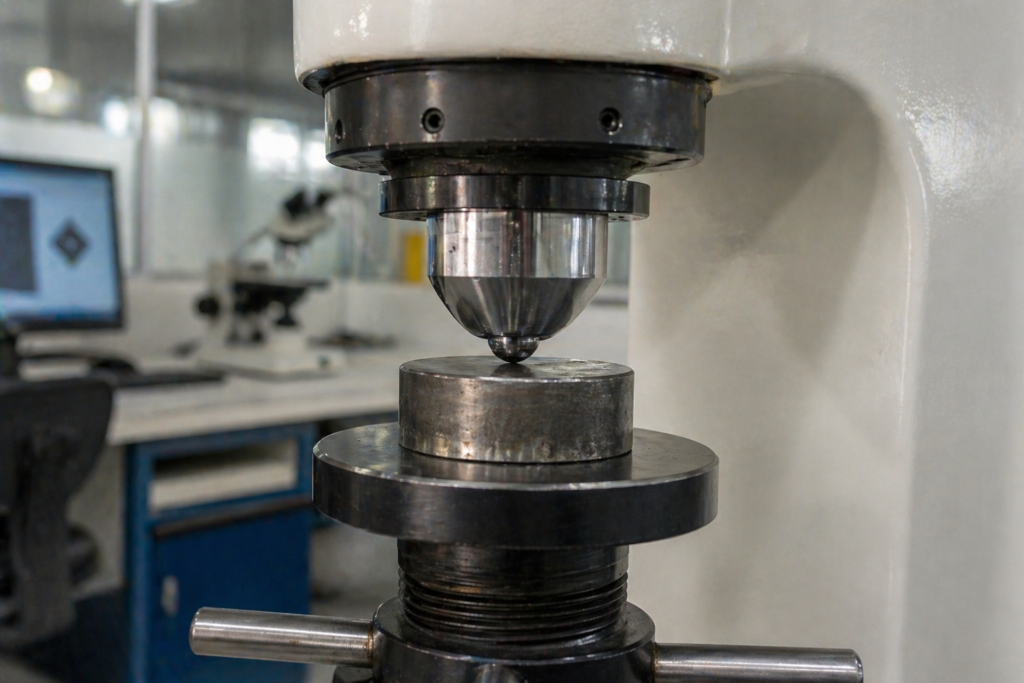
The Brinell hardness test uses a hardened steel or tungsten carbide ball (10mm diameter) pressed into the material surface under a specified load (typically 3000 kg for steel) for a standard dwell time. The diameter of the resulting indentation is measured optically, and the Brinell Hardness Number (HBW) is calculated as the load divided by the curved surface area of the indentation.
Brinell hardness is widely used for structural steels, forgings, castings, and heat-treated components in the HBW 100–450 range. Its large indenter averages local hardness variations, making it particularly useful for heterogeneous materials like castings and coarse-grained steels. However, its indentation is too large for thin sections or surface-hardened layers, and it cannot test very hard materials above approximately HBW 650 without indenter deformation.
- Rockwell Hardness (HRC, HRB, HRA)
The Rockwell test uses either a diamond cone indenter (Brale) or a hardened steel ball, applying a minor load followed by a major load and measuring the additional penetration depth. The Rockwell Hardness Number is inversely proportional to penetration depth — harder materials have higher Rockwell numbers. The test is fast, requires minimal surface preparation, and leaves a small indentation — advantages that make it the most widely used hardness test in production quality control.
The HRC scale (diamond indenter, 150 kg major load) is used for hard steels: quenched and tempered tool steels (HRC 40–65), case-hardened steel surfaces (HRC 55–65), and bearing steels (HRC 60–65). The HRB scale (1/16″ ball, 100 kg major load) is used for softer materials including annealed steel, aluminium, and brass (HRB 40–100). HRA (diamond, 60 kg) is used for cemented carbides and very hard materials.
- Vickers Hardness (HV)
The Vickers test uses a square-based diamond pyramid indenter pressed into the surface under loads ranging from 1 g (HV 0.001) to 100 kg (HV 100). The hardness number is calculated from the applied load and the diagonal length of the square indentation. The Vickers test is the most versatile hardness method — it can be applied from extremely soft materials to the hardest steels, using the same indenter geometry throughout, making it the only test that provides a truly continuous scale.
Micro-Vickers (loads below 1 kg) and nano-indentation testing allow hardness measurement of individual microstructural phases, carburized layers, weld heat-affected zones, and thin coatings. These capabilities make Vickers the standard method for quality control of surface-hardened components, carburized gears, and nitrided valve stems.
- Hardness Conversion and Practical Application
Hardness conversion between scales — HRC to HBW, HBW to tensile strength — is done using published conversion tables (ASTM E140, SAE J417) or approximate formulas. These conversions are empirical and material-specific: the conversion factors for carbon steel differ from those for stainless steel or case-hardened steel. For critical applications, hardness should always be measured directly rather than inferred from conversion.
When specifying steel products, buyers should state both the hardness scale and the required range clearly: for example, “Rockwell HRC 42–48” or “Brinell HBW 200–250.” Global Steel Industries’ technical team can advise on hardness specifications appropriate for your application and verify compliance through hardness testing at our supplier facilities.
- Conclusion
Understanding hardness testing is fundamental to specifying and verifying steel quality for heat-treated and wear-resistant applications. Global Steel Industries provides material test documentation including hardness results for all relevant products. Contact our team at globalsteelind.com for technical assistance.
Ready to source premium steel? Contact Global Steel Industries at globalsteelind.com or call 9324799893 / 9920397998