Steel Pipe Coatings & Linings: External and Internal Protection Systems
- Why Coating and Lining Are Essential
A bare steel pipe buried in soil or submerged in seawater will corrode rapidly — in aggressive soils, a carbon steel pipeline may lose 1mm of wall thickness per year through external corrosion, translating to failure of a standard pipe in as little as 5–10 years. For water transmission pipelines, internal corrosion not only threatens structural integrity but also compromises water quality through iron pick-up and microbial growth on corroded surfaces.
Pipeline coating and lining systems are therefore not optional extras — they are fundamental design elements that determine service life. A well-specified and correctly applied coating system can extend pipeline service life to 50 years or more, dramatically reducing the lifecycle cost of pipeline infrastructure. Global Steel Industries supplies coated and lined steel pipes for water distribution, gas transmission, and oil and gas gathering systems.
- Fusion Bonded Epoxy (FBE) Coatings
Fusion Bonded Epoxy is the dominant pipeline coating for natural gas distribution and transmission systems. A dry epoxy powder electrostatically applied to the pre-heated pipe surface melts, flows, and chemically cross-links on the hot steel to form a rigid, strongly adherent coating of 300–600 μm thickness. FBE provides excellent adhesion, low moisture permeability, and good resistance to cathodic disbondment — the tendency for coatings to delaminate under cathodic protection current.
Single-layer FBE is widely used for onshore natural gas distribution pipelines at moderate operating temperatures. Dual-layer FBE systems — a first layer of anti-corrosion FBE followed by a second layer of abrasion-resistant or flow-efficiency enhancing FBE — are specified for directional drilling applications and high-temperature service pipelines.
- Three-Layer Polyethylene and Polypropylene Systems
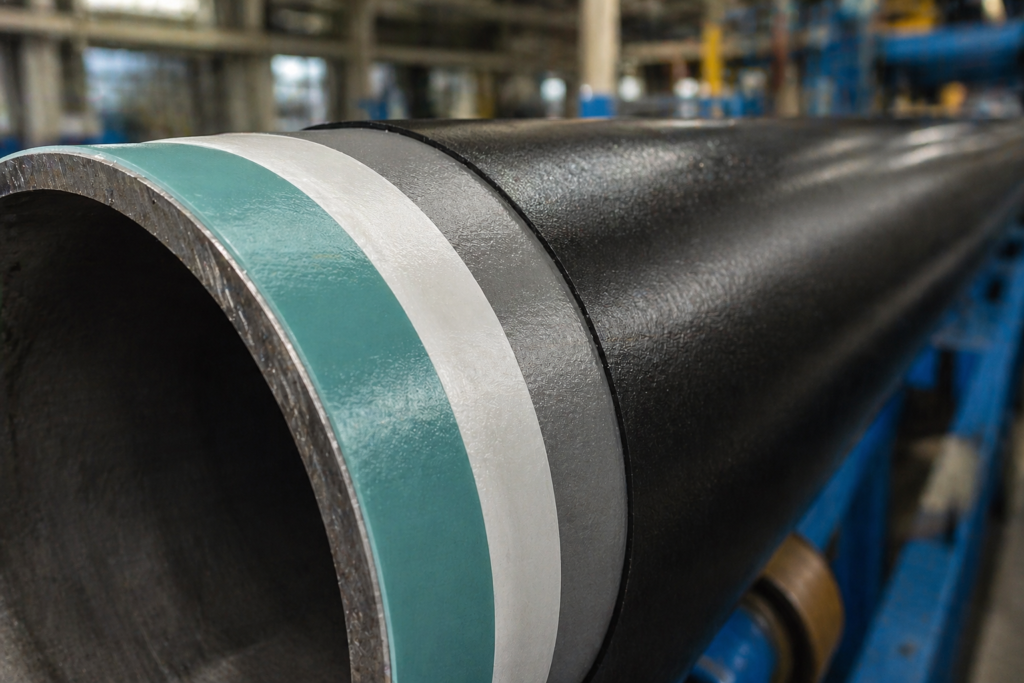
Three-layer PE (3LPE) and three-layer PP (3LPP) coating systems provide the highest level of external corrosion protection for buried onshore pipelines. The system comprises an inner FBE primer layer for adhesion to steel, an intermediate adhesive copolymer layer, and a thick outer layer of polyethylene (3LPE) or polypropylene (3LPP) for mechanical protection and moisture barrier performance. Total coating thickness ranges from 2.5mm to 5mm depending on pipe diameter and service conditions.
3LPE is the standard for onshore gas and oil transmission pipelines in Europe, the Middle East, and India where long-term corrosion protection with minimal maintenance is required. 3LPP, with its superior temperature resistance (service to +110°C compared to +80°C for HDPE), is specified for subsea flowlines and high-temperature onshore pipelines.
- Internal Lining Systems
Water transmission pipelines require internal lining to prevent corrosion, maintain hydraulic efficiency, and protect water quality. Cement mortar lining (CML), applied by centrifugal spinning inside the pipe, provides a hard, smooth, alkaline surface that inhibits iron dissolution and bacterial growth. CML is the most widely specified internal lining for potable water steel pipelines globally, conforming to standards including AWWA C205 and ISO 4179.
For sewage and wastewater pipelines where cement mortar is vulnerable to acidic attack, fusion bonded epoxy lining or high-build epoxy lining provides better chemical resistance. For industrial pipelines carrying corrosive process fluids, rubber lining (NR, EPDM, or Neoprene) bonded to the internal pipe surface provides flexibility and resistance to chemical attack and abrasion.
- Cathodic Protection Compatibility
All external pipeline coating systems are used in conjunction with cathodic protection (CP) systems — either impressed current or sacrificial anode — that provide electrochemical protection at any coating holidays (defects). The coating minimises the CP current demand, while the CP system protects any bare steel exposed at holidays. The two systems work synergistically: the better the coating, the less CP current is required, and the more effective the CP system is at protecting holidays.
CP compatibility requirements influence coating selection — specifically the coating’s resistance to cathodic disbondment and the temperature at which it can be reliably applied. Global Steel Industries can advise on coating system selection based on soil resistivity data, operating temperature, and CP design parameters.
- Conclusion
The right coating and lining system is as important as the pipe itself in determining pipeline service life and lifecycle cost. Global Steel Industries supplies coated and lined steel pipes meeting international pipeline coating standards. Contact us at globalsteelind.com to discuss your project’s pipeline protection requirements.
Ready to source premium steel? Contact Global Steel Industries at globalsteelind.com or call 9324799893 / 9920397998