Steel in the Defence Industry: Armour, Structural, and Specialist Grades
- Steel's Role in Defence Manufacturing
The defence industry demands steel that performs reliably under the most extreme conditions imaginable — blast loading, ballistic impact, extreme temperature, and structural overload. From armoured fighting vehicles to naval vessel hulls, from munitions casings to hardened shelters, steel is the foundational material of military hardware. Unlike commercial structural steel, defence-grade steels must meet exacting military specifications that combine high hardness with toughness — a combination that requires precise control of chemistry, heat treatment, and quality testing.
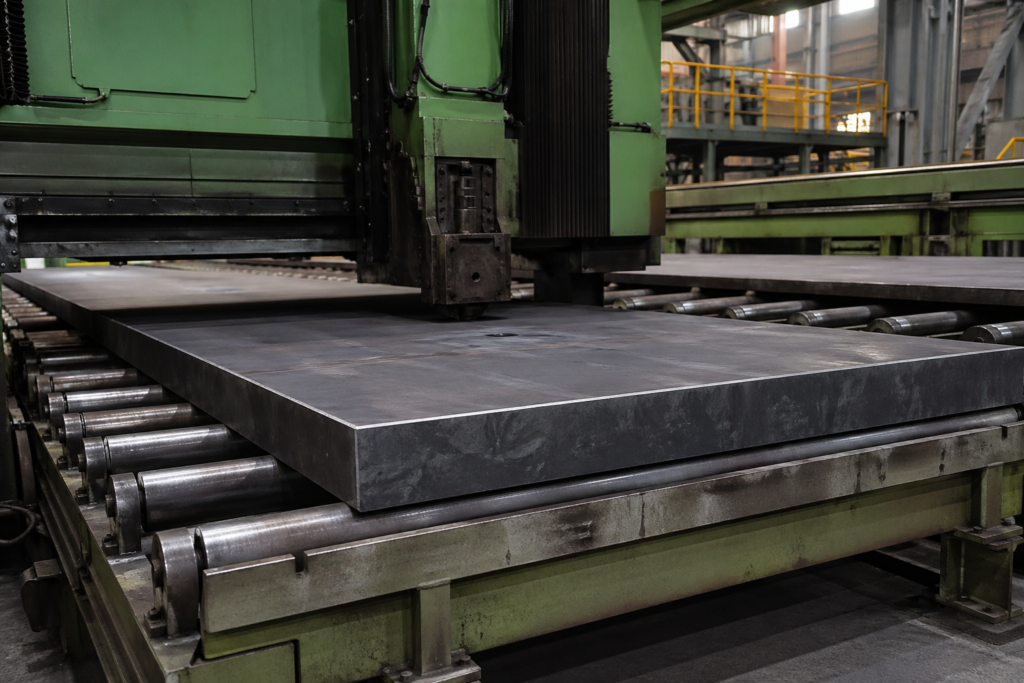
- Armour Steel: High-Hardness Plate
Ballistic armour plate must stop or retard penetration by projectiles while resisting fracture and spalling. This dual requirement of hardness and toughness is achieved through quenched and tempered high-alloy steels developed specifically for ballistic protection. Hardness levels of 400–600 HBW (Brinell Hardness) are typical, achieved through controlled carbon (0.25–0.45%), manganese, chromium, nickel, molybdenum, and boron alloying combined with through-thickness quenching.
Commercial armour steel grades including Miilux 500, Hardox HiAce, and ARMOX 500T are widely specified for military vehicle fabrication. MIL-DTL-12560 is the US military specification for rolled homogeneous armour (RHA) plate used in main battle tank and infantry fighting vehicle protection. European STANAG 4569 defines protection levels for light armoured vehicles, driving material specifications for lighter-weight armour systems.
- Naval Structural Steel
Warships impose unique requirements on structural steel that go beyond commercial classification society standards. Naval vessels must survive the shock loads from underwater explosions, near-miss blast from weapons, and the high cycle fatigue of high-speed sea operations in rough seas. DH36 and EH36 classification steels form the backbone of most naval surface combatant hull structures, supplemented by higher-strength grades such as Grade A and Grade D at 420–500 MPa yield for weight-critical applications.
Submarine pressure hull steel operates under external hydrostatic pressure of enormous magnitude — a submarine at 300m depth experiences 30 bar (3 MPa) external pressure. HY-80, HY-100, and HY-130 (yield strengths of 80, 100, and 130 ksi respectively) are the US Navy’s high-yield submarine hull steels, requiring exceptional toughness and resistance to hydrogen-induced cracking
- MIL-Spec Structural and Ground Support Equipment
Beyond hull and armour, defence procurement includes vast quantities of structural steel for military facilities, forward operating base infrastructure, portable bridging systems, ammunition storage, and ground support equipment. These applications require structural steels conforming to military specifications that extend commercial grades with additional requirements for impact testing, surface condition, and chemical composition restrictions on elements that could compromise welding performance in field conditions.
Military bridging systems — whether scissors bridges on armoured vehicles or modular panel bridges like the Mabey-Johnson system — use high-tensile steel plates and sections with yield strengths of 600 MPa and above, capable of carrying battle tanks of 60+ tonnes over river crossings of 50+ metres.
- Documentation and Security of Supply
Defence procurement places exceptional demands on documentation, traceability, and security of supply. Every plate, bar, and pipe must be traceable to its originating heat with chemical analysis, mechanical test results, and heat treatment records. Counterfeit materials — a significant risk in global supply chains — can have catastrophic consequences in defence applications. Qualified supplier lists, approved mill databases, and independent inspection requirements are standard elements of defence steel procurement specifications.
Global Steel Industries maintains strict supply chain integrity processes and works exclusively with mills holding relevant quality system certifications. For defence project inquiries, our team provides tailored documentation packages meeting specific military specification requirements.
- Conclusion
Defence-grade steel demands the highest levels of metallurgical quality, documentation integrity, and supply chain reliability. Global Steel Industries is equipped to meet these standards. Contact our specialist team at globalsteelind.com for defence material inquiries.
Ready to source premium steel? Contact Global Steel Industries at globalsteelind.com or call 9324799893 / 9920397998