Titanium in Industry: Why It Competes with Steel in Extreme Applications
- Titanium's Unique Property Profile
Titanium occupies a unique position among structural metals: it delivers corrosion resistance comparable to platinum-group metals, a strength-to-weight ratio superior to most steels, and complete biocompatibility with the human body — all in a commercially producible form. Its density of 4.51 g/cm³ is just 57% of steel’s, yet its commercially pure grades develop yield strengths of 170–480 MPa, and its titanium alloys reach 800–1100 MPa — rivalling high-strength steels at nearly half the weight.
The corrosion resistance of titanium derives from an exceptionally stable titanium dioxide (TiO₂) passive film that reforms instantaneously when damaged. This passive layer is resistant to chlorides, oxidising acids, wet chlorine gas, and most organic chemicals — environments that destroy stainless steel in months. In seawater service, titanium is essentially immune to crevice corrosion and pitting — failure modes that are major design challenges for even super duplex stainless steel.
- Titanium Grades and Alloys
Commercially pure (CP) titanium grades 1 through 4 are classified by increasing oxygen content, which raises strength at the cost of ductility. Grade 2 CP titanium is the most widely used — it combines adequate strength (yield ~275 MPa) with excellent formability and weldability, making it the standard for chemical process equipment, heat exchanger tubes, and marine components.
Titanium alloy Grade 5 (Ti-6Al-4V), containing 6% aluminium and 4% vanadium, is the dominant aerospace alloy, accounting for approximately 50% of all titanium alloy usage. Its combination of 880 MPa yield strength, excellent fatigue resistance, and low density makes it the material of choice for aircraft structural components, gas turbine fan blades, and orthopaedic implants. Grade 12 (Ti-0.3Mo-0.8Ni) offers enhanced crevice corrosion resistance compared to CP grades, targeted at chemical process and desalination applications.
- Chemical Process and Desalination Applications
Titanium’s dominance in chemical process equipment serving hot, concentrated acids and oxidising environments is well established. Heat exchangers for nitric acid, acetic acid, and chlorine service routinely specify titanium tube bundles where stainless steel would fail within months. The thin walls possible in titanium heat exchangers — enabled by its high corrosion resistance eliminating corrosion allowance — also improve heat transfer efficiency.
Desalination plants, particularly multi-stage flash units and reverse osmosis systems, use titanium tubes in condenser and heat recovery sections where seawater velocity, temperature, and chloride concentration combine to create conditions that test the limits of even the most resistant stainless alloys. Titanium’s complete immunity to seawater corrosion makes it the specification of choice for these critical components.
- Biomedical and Orthopaedic Applications
Titanium and its alloys dominate the orthopaedic and dental implant market for compelling reasons. Its biocompatibility — the absence of any adverse biological response to titanium in the human body — makes it uniquely suited for permanent implantation. Osseointegration, the direct structural bonding of bone to the titanium implant surface, provides long-term mechanical stability for joint replacements, bone screws, dental implants, and spinal fusion devices.
Grade 23 (Ti-6Al-4V ELI — Extra Low Interstitials) is the premium grade for medical implants, with tightly controlled oxygen and iron contents that improve ductility and fracture toughness. For permanent implants where fatigue life is critical, the alloy’s endurance limit — the stress below which fatigue does not occur — must be carefully documented and maintained.
- Cost and Availability Considerations
Titanium commands a significant price premium over steel — typically 10 to 25 times the cost per kilogram of stainless steel grades — reflecting the energy-intensive Kroll process used to extract titanium from its ores. This premium must be justified by genuine performance advantages in the specific application. Life-cycle cost analysis frequently supports the titanium premium in corrosive service environments where steel alternatives require frequent replacement or intensive maintenance.
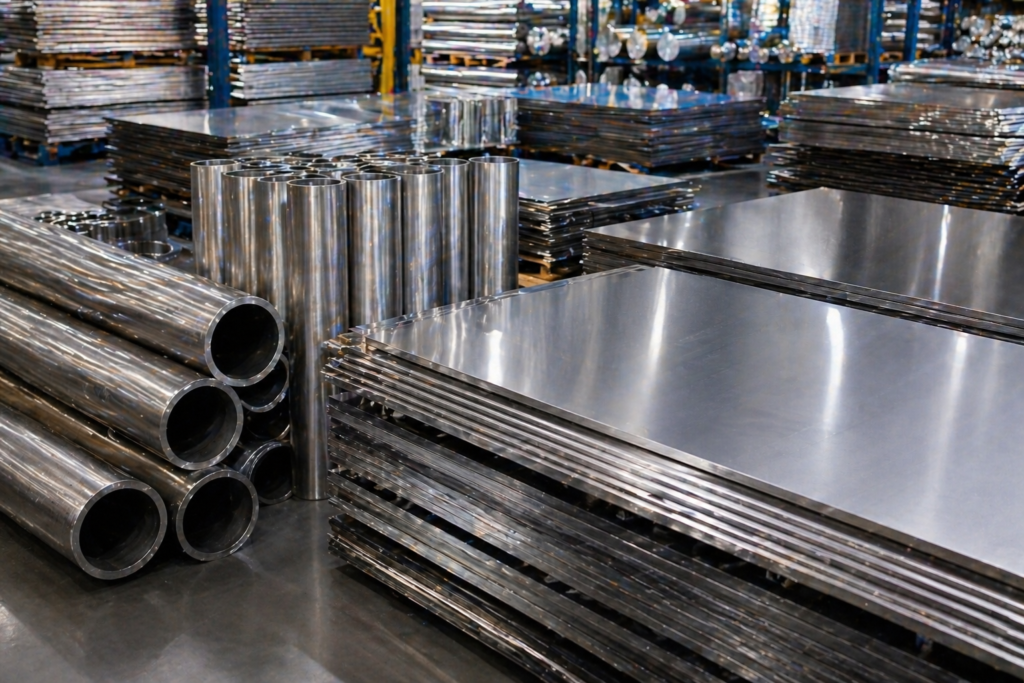
Global Steel Industries supplies titanium plates, sheets, tubes, and bars in CP Grade 2, Grade 5 (Ti-6Al-4V), and Grade 12 with full material traceability and certifications. Our specialty metals team can assist with grade selection and application engineering
- Conclusion
When conventional steel reaches its performance limits, titanium is often the solution. Global Steel Industries provides access to titanium and specialty metal products alongside our core steel range. Contact us at globalsteelind.com to discuss your specialty metals requirements.
Ready to source premium steel? Contact Global Steel Industries at globalsteelind.com or call 9324799893 / 9920397998