Bearing Steel & Precision Steel: Grades, Cleanliness & Applications
- The Demands of Bearing Applications
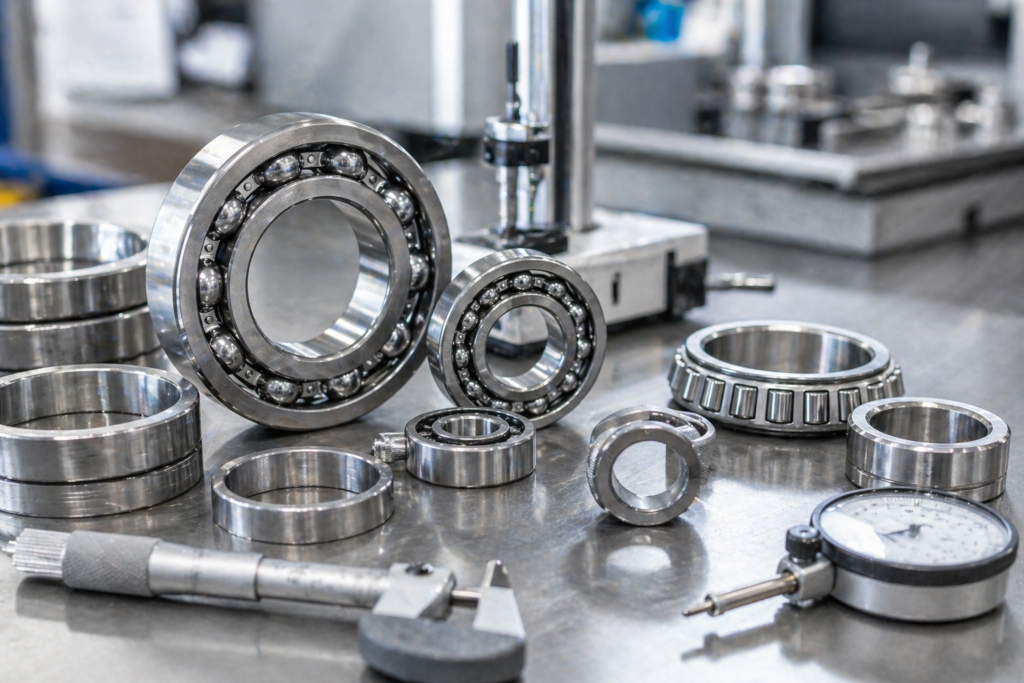
Rolling element bearings — ball bearings, cylindrical roller bearings, tapered roller bearings, and needle bearings — are among the most demanding applications for steel in all of engineering. A bearing inner ring in a high-speed spindle may rotate at 20,000 rpm, with each rolling element contact point experiencing compressive stresses of 1,500–3,000 MPa every revolution. Over a bearing’s rated life of 10⁷ to 10⁸ load cycles, any defect in the steel — a non-metallic inclusion, a surface scratch, or a local hardness variation — becomes a potential fatigue initiation site.
This extraordinary performance requirement drives the quality standards for bearing steel to levels that exceed virtually all other commercial steel products. Steel cleanliness (freedom from non-metallic inclusions), dimensional precision, surface quality, and microstructural uniformity must all be controlled to the highest standards achievable by modern steelmaking.
- Grade 100Cr6: The Universal Bearing Steel
Grade 100Cr6 (ISO 683-17, equivalent to AISI 52100 in the USA) is the dominant bearing steel globally, accounting for the vast majority of bearing ring and rolling element production worldwide. With 0.95–1.10% carbon and 1.35–1.65% chromium, it achieves the hardness of HRC 60–65 after quench and tempering that bearing contact surfaces require, while maintaining the fracture toughness needed to resist ring and rolling element cracking.
The critical quality requirement for 100Cr6 is cleanliness — the restriction of oxygen content, sulphide inclusion size, and carbide heterogeneity to very low levels. Modern bearing-grade 100Cr6 is produced by vacuum degassing and electric arc furnace or ladle refining processes that achieve oxygen contents below 10 ppm. Fatigue life is proportional to steel cleanliness — improvements in steelmaking practice over the past 30 years have increased bearing life ratings by factors of three to ten.
- High-Temperature Bearing Steels
Standard 100Cr6 loses hardness above approximately 150°C due to over-tempering of its martensitic microstructure — a critical limitation for bearings in aircraft engines, gas turbines, and high-speed machine tool spindles. For elevated temperature service, carbonitrided 100Cr6 or case-hardened steels can extend the temperature range slightly, but the most demanding applications require fully alloyed hot-work tool steels or M-series high-speed steels.
M50 (0.80% C, 4.0% Cr, 4.5% Mo, 1.0% V) is the standard bearing steel for main shaft bearings in aircraft gas turbine engines, maintaining adequate hardness up to approximately 315°C. M50-NiL (a case-hardening variant with a tough carburized core) provides improved fracture resistance for bearings subject to combined fatigue and impact loading in military aviation applications.
- Precision Grinding and Dimensional Tolerances
Bearing ring manufacture involves a sequence of turning, hardening, and precision grinding operations that progressively refine dimensions to tolerances measured in micrometers. ABEC (Annular Bearing Engineers Committee) tolerance grades from ABEC-1 (least precise) to ABEC-9 (most precise) define dimensional tolerances for bore diameter, outer diameter, ring width, and runout. Precision spindle bearings for machine tool applications are manufactured to ABEC-7 and ABEC-9, with bore diameter tolerances of ±2.5 to ±1.25 micrometers.
Achieving these tolerances consistently requires bearing steel with excellent dimensional stability during heat treatment — minimal distortion from quenching, and stable retained austenite content after tempering. Steel bar straightness, roundness, and surface quality of the incoming bar stock all affect the economics of grinding operations.
- Global Steel Industries Supply Capability
Global Steel Industries supplies bearing steel bar in 100Cr6 and other grades in a range of diameters from 10mm to 150mm, in spheroidized-annealed condition ready for machining. Cleanliness certification per ASTM E45 or DIN 50602, chemical analysis to IS 6516/ISO 683-17, and dimensional conformance to specified tolerances are documented in material test certificates supplied with every order.
- Conclusion
Bearing steel demands the highest level of steelmaking precision and quality documentation. Global Steel Industries delivers both — with every order traceable, certified, and ready for inspection. Contact us at globalsteelind.com to discuss your bearing steel requirements.
Ready to source premium steel? Contact Global Steel Industries at globalsteelind.com or call 9324799893 / 9920397998