Spring Steel: Grades, Properties & Industrial Applications
- What Is Spring Steel?
Spring steel is a group of medium-to-high carbon and alloy steels specifically engineered to withstand repeated elastic deformation without permanent set. Unlike structural steels that are designed to remain rigid under load, spring steels must flex, absorb energy, and return to their original shape millions of times over their service life. This unique requirement demands a combination of high yield strength, high resilience, and excellent fatigue resistance — properties achieved through careful alloy design and heat treatment.
The carbon content of spring steels typically falls between 0.50% and 1.00%, providing the hardness and yield strength needed for elastic performance. Alloying elements including manganese, silicon, chromium, vanadium, and molybdenum are added to enhance hardenability, temper resistance, and fatigue life. The heat treatment sequence — quenching and tempering to a carefully controlled hardness — is critical to achieving the balance of strength and toughness required.
- India's Steel Export Competitive Advantages
India’s steel industry benefits from several structural competitive advantages that translate directly into value for international buyers. Domestic iron ore reserves of approximately 33 billion tonnes provide a secure, competitively priced raw material foundation for steelmakers. Coking coal, while largely imported, is sourced efficiently through established supply chains to the major east coast ports. Labour costs, while rising, remain competitive compared to European, Japanese, and South Korean producers.
Major Indian integrated steel plants including JSW Steel, Tata Steel, Steel Authority of India (SAIL), AM/NS India, and JSPL operate at world-class efficiency levels with modern production technology. Many have achieved international quality certifications and third-party approvals from classification societies and international agencies, enabling them to supply to demanding global standards. This combination of cost competitiveness and quality capability makes Indian steel a compelling proposition for procurement teams worldwide.
- Key Spring Steel Grades
Grade 65Mn (0.65% C, 1.0% Mn) is the most widely used spring steel in India and Asia, offering a practical combination of cost, hardenability, and spring performance for automotive leaf springs, flat springs, and coil springs in moderate-duty applications. It is produced to IS 3431 and equivalent standards.
Grade SUP9 (0.52–0.60% C, 0.65–0.95% Si, 0.65–0.95% Mn, 0.70–1.00% Cr) is a chromium-silicon-manganese spring steel widely used for heavy-duty automotive leaf springs and stabiliser bars. Grades 52CrMoV4 and 51CrV4 are premium chromium-vanadium spring steels offering excellent fatigue life at elevated temperatures, making them the standard for automotive valve springs, high-performance suspension components, and precision industrial springs.
- Automotive Leaf Springs and Coil Springs
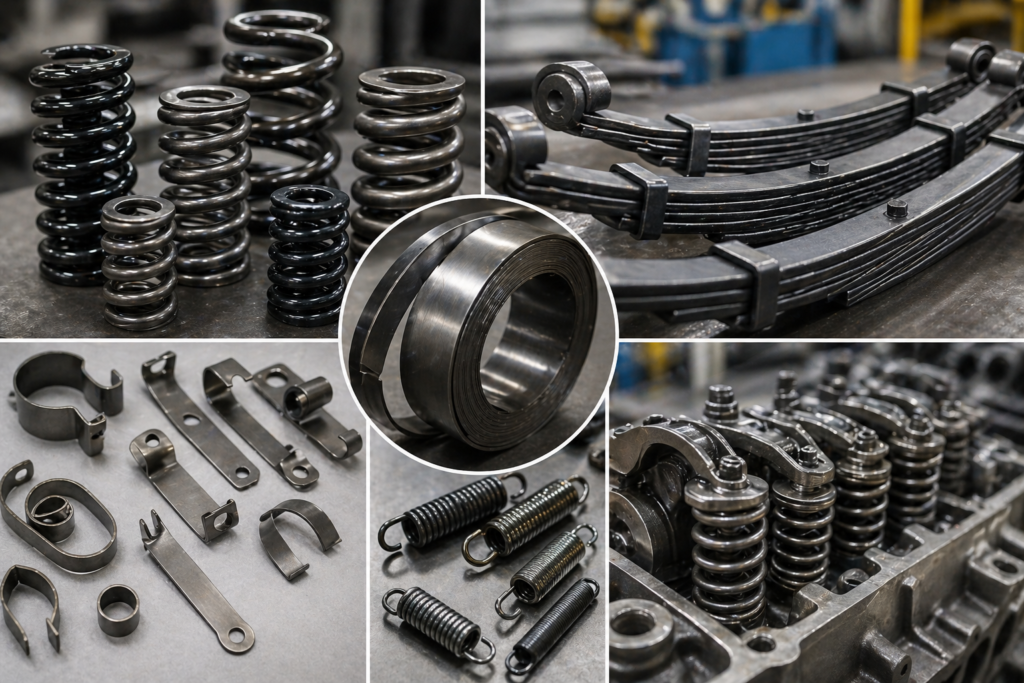
Leaf springs remain the dominant suspension component in commercial vehicles — trucks, buses, and trailers — where their simplicity, high load capacity, and ability to absorb road shock make them economically and technically attractive. Multiple leaves of spring steel, each shaped to a parabolic profile, are stacked and clamped to form a progressive-rate spring assembly. Shot peening of the tensile surface introduces beneficial compressive residual stresses that dramatically improve fatigue life.
Coil springs, produced by hot or cold winding of round or rectangular spring steel bar, are the standard suspension spring for passenger vehicles. Valve springs — small, precision-wound coil springs operating at high frequency in engine valve trains — represent one of the most fatigue-critical spring applications, requiring premium spring steel grades with tightly controlled surface quality and very high cleanliness.
- Rail and Industrial Applications
Railway applications consume significant quantities of spring steel in the form of clip springs — fasteners that hold rails to sleepers — and buffer springs that absorb impact energy in rolling stock couplings. The combination of high cycle fatigue resistance and corrosion resistance required in outdoor railway environments demands careful material and coating specification.
Industrial applications include die springs in pressing tools, snap rings and retaining clips, clock and instrument springs, and industrial buffer and vibration isolation springs. Each application has specific requirements for wire or strip cross-section, surface finish, and heat treatment condition that must be matched to the spring steel specification.
- Processing and Surface Treatment
Spring steel components undergo several processing steps after forming. Heat treatment — oil quenching from approximately 850°C followed by tempering at 400–500°C — develops the hardness of HRC 42–52 required for spring performance. Shot peening of formed springs induces compressive surface stresses that counter the tensile fatigue stresses developed during flexing, extending fatigue life by a factor of two to three.
Surface protection of carbon spring steel from corrosion is essential for outdoor applications. Options include hot-dip galvanizing for leaf springs, phosphating and painting for automotive coil springs, and electro-plating with zinc or cadmium for precision industrial springs. Global Steel Industries supplies spring steel strip, bar, and coil in annealed and pre-tempered conditions.
- Conclusion
Spring steel is a precision engineering material where metallurgical control and processing excellence directly determine product performance and service life. Global Steel Industries supplies spring steel in all standard grades with full material certifications. Contact our team at globalsteelind.com for specifications and pricing.
Ready to source premium steel? Contact Global Steel Industries at globalsteelind.com or call 9324799893 / 9920397998