Boiler Tubes & Heat Exchanger Tubes: Material Selection Guide
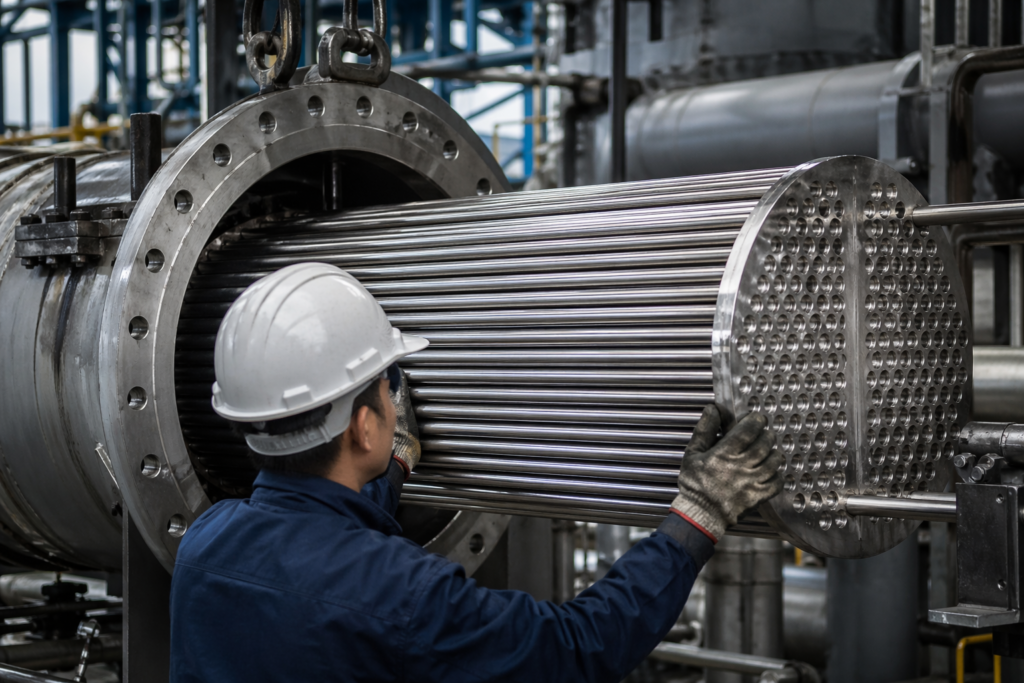
Boiler tubes and heat exchanger tubes are among the most technically demanding tubular products in the industrial market. Operating continuously under pressure at elevated temperatures, often in contact with aggressive flue gases externally and high-pressure steam or process fluids internally, these tubes must maintain their mechanical properties and resist corrosion for decades without failure. Global Steel Industries supplies certified boiler and heat exchanger tubes to power generation plants, refinery operators, and chemical process industries across India and internationally
- Classification Society Standards for Shipbuilding Steel
The seven major classification societies — Lloyd’s Register, Bureau Veritas, DNV, ABS, ClassNK, RINA, and KR — collectively publish the Rules for Materials and Welding that govern steel used in ship construction. These rules define grades, mechanical requirements, chemical composition limits, inspection requirements, and the approval procedures for steel mills. Only plates produced by approved mills carrying the classification society mark are acceptable for hull construction.
Classification steel plates are produced to normal-strength (Grade A, B, D, E) and high-strength categories. Normal-strength grades have a minimum yield strength of 235 MPa. High-strength plates are grouped into three yield strength levels: AH/DH/EH grades at 315 MPa minimum, FH/AH36/DH36/EH36 at 355 MPa minimum, and AH40/DH40/EH40 at 390 MPa minimum.
- Carbon Steel Boiler Tube Grades
For conventional steam boiler applications at moderate temperatures (below approximately 450°C), carbon steel tubes specified to ASME SA210 Grade A1 and Grade C are the standard choice. SA210 A1 is a medium-carbon steel tube with minimum tensile strength of 415 MPa, widely used in water walls, economizers, and superheater/reheater circuits at moderate temperatures. SA210 Grade C, with higher carbon content and 485 MPa minimum tensile strength, is specified for higher-pressure applications.
For heat exchanger tube bundles in refineries and chemical plants operating at moderate temperatures, ASME SA179 (cold-drawn seamless low-carbon steel) and SA214 (electric-resistance welded low-carbon steel) are the workhorses. Their excellent heat transfer coefficients, combined with good corrosion resistance in non-aggressive service, make them the most economically rational choice for the majority of shell-and-tube heat exchanger applications.
- Stainless Steel Heat Exchanger Tubes
When process fluid chemistry demands corrosion resistance beyond the capability of carbon or low-alloy steels, stainless steel heat exchanger tubes become the material of choice. ASME SA213 TP304L, TP316L, and TP317L austenitic stainless tubes are specified for process heat exchangers handling corrosive acids, chloride-containing process streams, and food or pharmaceutical grade fluids.
Duplex stainless grades (2205, TP2507) in tube form offer the advantage of higher strength compared to austenitic grades, allowing thinner tube walls for improved heat transfer, while providing superior resistance to stress corrosion cracking in chloride-rich cooling water applications. Titanium tubes are specified for the most demanding applications involving seawater cooling and highly corrosive process streams
- Alloy Steel Tubes for High-Temperature Service
As operating temperatures increase beyond 450°C in modern high-efficiency power boilers, chromium-molybdenum alloy steel tubes become essential. The T11 grade (1.25% Cr, 0.5% Mo, ASME SA213 T11) offers improved strength and oxidation resistance compared to carbon steel at temperatures up to approximately 540°C. T22 (2.25% Cr, 1% Mo) extends the temperature envelope further to approximately 580°C.
For ultra-supercritical boilers operating above 600°C — a key design requirement for maximizing thermal efficiency and minimizing CO₂ emissions — Grade T91 (9% Cr, 1% Mo, with vanadium and niobium additions) provides the required combination of creep strength and oxidation resistance. T91 is now widely specified in new high-efficiency power boilers globally and represents one of the most technically demanding tube grades in commercial production.
- Tube Testing and Quality Standards
Boiler and heat exchanger tubes are subject to stringent manufacturing quality requirements. Every tube undergoes hydrostatic pressure testing or eddy-current non-destructive testing to verify freedom from leakage paths and injurious defects. Dimensional inspection confirms outer diameter, wall thickness, and straightness within
tolerance. Chemical analysis and mechanical testing of heat samples document compliance with specified grade properties.
Global Steel Industries supplies boiler and heat exchanger tubes from mills holding ASME quality system certificates (QSC), with EN 10204 3.1 material test certificates and national board certified mill documentation where required.
- Conclusion
Selecting the right tube material for your boiler or heat exchanger is a critical decision with long-term operational consequences. Global Steel Industries provides expert technical guidance and certified tubes across the full range of carbon, alloy, and stainless steel grades. Reach our team at globalsteelind.com for product selection assistance.
Ready to source premium steel? Contact Global Steel Industries at globalsteelind.com or call 9324799893 / 9920397998