Steel Pipes for Oil & Gas: Specifications, Standards & Sourcing Guide
The oil and gas industry is one of the most demanding consumers of steel pipes in the world. From upstream drilling and gathering systems to midstream transmission pipelines and downstream refinery piping, every segment relies on pipes that can withstand extreme pressure, temperature, and corrosive environments. At Global Steel Industries, headquartered in Bhiwandi, Mumbai, we supply a comprehensive range of oil and gas grade steel pipes backed by internationally recognized certifications and over two decades of supply chain expertise.
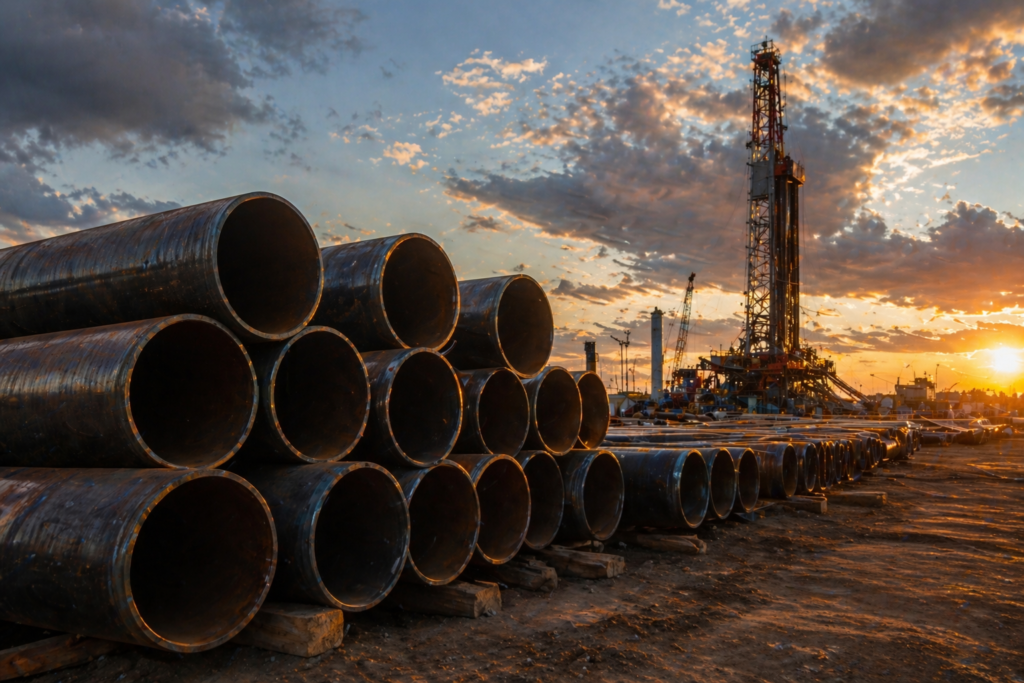
- Key Standards for Oil & Gas Steel Pipes
The foundation of any oil and gas piping specification is conformance to recognized international standards. API 5L is the dominant standard governing line pipes used in pipeline transportation systems for natural gas, water, and petroleum. It defines grades from Grade B through X80 and higher, with PSL-1 and PSL-2 product specification levels. PSL-2 imposes more stringent requirements on chemical composition, mechanical properties, heat treatment, and non-destructive examination.
For process piping within refineries, ASTM A106 Grade B and Grade C govern seamless carbon steel pipes for high-temperature service. ASTM A333 covers low-temperature service pipes with Charpy impact testing requirements at sub-zero temperatures. ASTM A335 specifies seamless ferritic alloy steel pipes for high-temperature service, including the widely used P11, P22, and P91 grades that are staples of refinery and power plant piping systems.
- Line Pipe Grades and Pressure Ratings
API 5L pipe grades are designated by their minimum yield strength in ksi. Grade X52 (minimum yield 52,000 psi) is commonly used in gas gathering systems and moderate-pressure transmission lines. Grade X65 and X70 are the workhorses of high-pressure gas transmission networks, offering excellent combinations of strength, toughness, and weldability. Grade X80 is increasingly specified for large-diameter, high-pressure gas transmission pipelines where wall thickness reduction translates directly into material cost savings.
The pressure-temperature rating of any pipe is a function of its specified minimum yield strength, wall thickness, outer diameter, and applicable design code factors. ASME B31.4 governs liquid petroleum transmission pipelines, while ASME B31.8 covers gas transmission and distribution piping systems. Global Steel Industries can supply pipes to any of these specifications with full documentation
- Corrosion Protection for Pipeline Applications
Pipeline corrosion is the leading cause of integrity failures and unplanned shutdowns in the oil and gas industry. Both internal and external corrosion protection strategies are essential for long-service-life pipelines. External coating systems, including fusion-bonded epoxy (FBE), three-layer polyethylene (3LPE), and three-layer polypropylene (3LPP), form the first line of defense against soil-side corrosion in buried pipelines.
Internal flow assurance coatings reduce friction and protect against sweet and sour corrosion in wet gas and produced water service. For sour service environments containing hydrogen sulfide, NACE MR0175/ISO 15156 compliance is mandatory, requiring sulphide stress cracking (SSC) resistant materials and controlled hardness. Global Steel Industries supplies sour service compliant pipes with appropriate material certifications
Hydrostatic pressure testing of every pipe joint verifies pressure containment integrity. Dimensional inspection confirms wall thickness, outer diameter, ovality, and end geometry are within tolerance.
Chemical composition verification by optical emission spectrometry or X-ray fluorescence ensures the steel meets specified grade requirements. Mechanical testing including tensile, yield, elongation, and Charpy V-notch impact testing confirms the pipe meets its specified minimum properties. Global Steel Industries provides complete documentation packages, including mill test certificates, third-party inspection reports, and certificates of conformance for every pipe shipment.
- Why Global Steel Industries for Oil & Gas Pipes
Our supply network spans mills in India, Japan, South Korea, and Europe, giving us access to qualified manufacturers for virtually any API 5L or ASTM specification required. We have extensive experience serving oil and gas clients in the Middle East, Southeast Asia, and Africa — regions where project timelines are tight and quality requirements are absolute. Our technical team is available to assist with grade selection, specification review, and third-party inspection coordination.
- Conclusion
Steel pipes for oil and gas applications require not just material compliance but complete supply chain integrity. Global Steel Industries delivers both — every time. Contact our team at globalsteelind.com to discuss your pipe requirements and receive a competitive quotation. click here
Ready to source premium steel? Contact Global Steel Industries at globalsteelind.com or call 9324799893 / 9920397998