Understanding Steel Flanges: Types, Standards & Applications
Steel flanges are critical components in piping systems across oil and gas, chemical processing, water treatment, and power generation industries. They enable the secure, leak-proof joining of pipes, valves, pumps, and equipment. Choosing the correct flange type, pressure rating, and material is essential for system integrity and safety
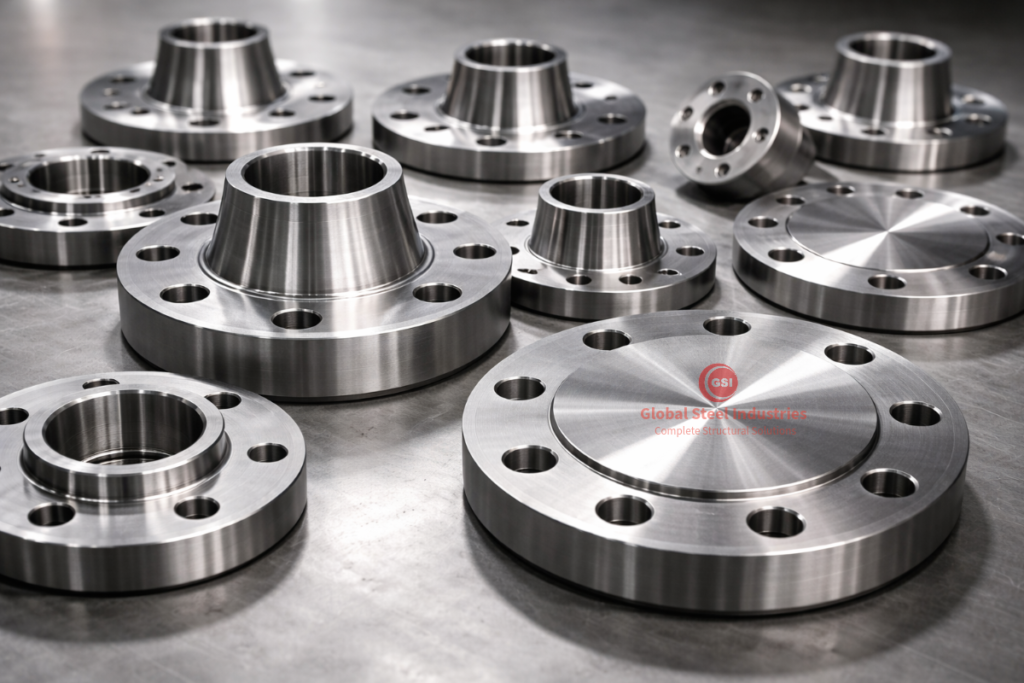
- What Is a Steel Flange?
A flange is a disc, ring, or collar of steel forged or cast with bolt holes around its perimeter. Two flanges are bolted together with a gasket between their faces to create a pressure-tight joint. Flanges allow piping systems to be disassembled for maintenance, cleaned, inspected, or modified. They are manufactured to international standards including ASME B16.5, ASME B16.47, DIN, BS, and IS 6392.
- Types of Steel Flanges
Weld Neck Flange (WNF): Has a long tapered hub welded to the pipe; ideal for high-pressure, high-temperature applications. Slip-On Flange (SOF): Slips over the pipe and is fillet-welded; easy to install, lower cost. Blind Flange: A solid disc used to close the end of a piping system. Socket Weld Flange: Pipe inserts into a socket and is fillet-welded; used for small-diameter, high-pressure lines. Lap Joint Flange: Used with stub ends; allows rotation for easy bolt alignment. Threaded Flange: Screws onto threaded pipe ends; no welding required, used in low-pressure applications. Orifice Flange: Used with orifice plates for flow measurement.
- Pressure Ratings & Classes
Flanges under ASME B16.5 are rated in pressure classes: Class 150, 300, 600, 900, 1500, and 2500. Higher class numbers indicate higher pressure ratings. The allowable pressure at a given temperature depends on the material group. For example, a Class 300 carbon steel flange (Group 1.1) is rated for 51.1 bar at 38°C. Always verify the pressure-temperature rating for your specific material and operating conditions
- Facing Types
The flange face is the surface that contacts the gasket. Common facing types include: Raised Face (RF) — the most common; a raised ring on the flange face concentrates gasket stress. Flat Face (FF) — entire face is flat; used with full-face gaskets in cast iron systems. Ring Type Joint (RTJ) — a
machined groove that accepts a metal ring gasket; for high-pressure, high-temperature service. Male and Female (M&F) and Tongue and Groove (T&G) — interlocking faces for precise gasket seating.
- Material Selection
Flanges are available in a wide range of materials: Carbon steel (ASTM A105, A350 LF2 for low temperature), Alloy steel (ASTM A182 F11, F22 for high temperature), Stainless steel (ASTM A182 F304, F316, F316L for corrosive service), Duplex stainless steel (F51, F53 for aggressive chemical environments), and Nickel alloys (F625, F825 for extreme conditions). Material selection must consider the fluid being handled, operating temperature, pressure, and corrosion potential.
- Key Standards Reference
ASME B16.5: Pipe flanges and flanged fittings NPS ½ through NPS 24. ASME B16.47: Large diameter flanges NPS 26 through NPS 60. EN 1092-1: European standard for steel flanges. IS 6392: Indian standard for steel pipe flanges. Always specify the standard, class, facing type, and material in your purchase order.
- Conclusion
Steel flanges are deceptively simple components with significant engineering complexity behind their specification. Getting the type, rating, and material right is essential for system safety and longevity. Global Steel Industries supplies carbon steel, alloy steel, and stainless steel flanges to ASME, EN, and IS standards for industrial piping systems. Contact our team for datasheets and competitive quotes.
Ready to source premium steel? Contact Global Steel Industries at globalsteelind.com or call 9324799893 / 9920397998