Angle Iron & Steel Angles: Uses, Sizes & Selection Guide
Steel angles — commonly known as angle iron — are one of the most versatile and widely used structural steel sections in construction, fabrication, and manufacturing. Their simple L-shaped profile belies the enormous range of applications they support, from structural frameworks to decorative trim. This guide covers everything you need to know about steel angles.
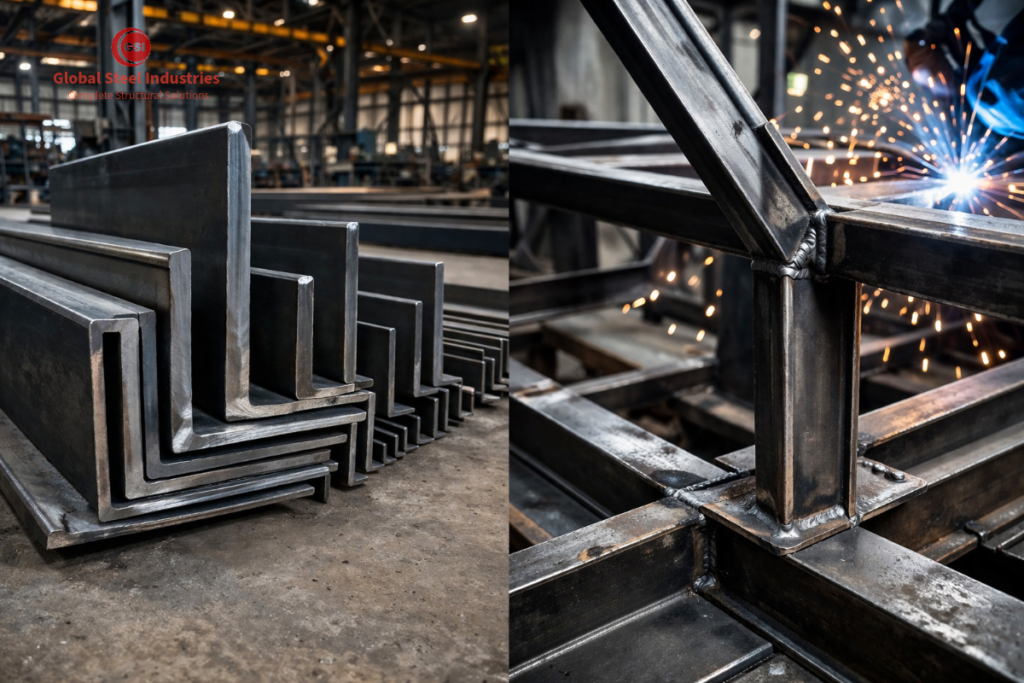
- What Is a Steel Angle?
A steel angle is an L-shaped cross-section structural steel bar produced by hot rolling. It consists of two legs meeting at a 90-degree angle. Angles are classified as equal angles (both legs of the same length) and unequal angles (legs of different lengths). Common designation examples: ISA 50x50x5 (equal) and ISA 100x75x8 (unequal) per Indian Standard IS 808. They are produced in lengths typically ranging from 6 to 12 meters.
- Manufacturing Process
Steel angles are produced via hot rolling, where a steel billet is passed through a series of shaped rollers to form the characteristic L-profile. They can also be formed by bending flat bar or plate for specialized applications. Hot rolled angles have mill scale on the surface and are available in mild steel, high tensile, stainless steel, and weathering steel grades.
- Standard Sizes & Specifications
Equal angles range from ISA 20x20x3 to ISA 200x200x25 under IS 808. Unequal angles range from ISA 30x20x3 to ISA 200x150x18. Internationally, angles are specified under ASTM A36, EN 10056, and JIS G3192 standards. Thickness ranges from 3mm to 25mm. The choice of size depends on the load-bearing requirements and the structural design
- Common Applications
Steel angles are used in an extraordinary range of applications including structural framing and bracings in buildings and industrial sheds, transmission and communication tower fabrication, shelving and racking systems, vehicle and trailer chassis, conveyor support structures, agricultural machinery, window and door frames, decorative trim and edge protection, and welded box sections. Their simplicity makes them easy to cut, drill, weld, and bolt.
- Equal vs Unequal Angles: When to Use Which
Equal angles are the default choice for general structural applications where loading is uniform and symmetrical — corner bracing, shelf supports, frame members. Unequal angles are used when different load capacities are needed in each direction, for beam-to-column connections, or where space constraints require a wider flange in one direction. They offer more design flexibility for complex connections.
- Material Grade Selection
For standard structural use, IS 2062 E250 Grade A or B is sufficient. For high-load or dynamic applications, IS 2062 E350 or E410 grades are recommended. Stainless steel angles (SS 304, SS 316) are used in food processing, marine, and chemical environments. Galvanized angles are preferred for outdoor and corrosive environments. Specify the grade clearly in your procurement documents.
- Conclusion
Steel angles are indispensable in virtually every construction and fabrication project. Their versatility, availability in multiple grades and sizes, and ease of fabrication make them a go-to structural element. Global Steel Industries stocks a comprehensive range of equal and unequal steel angles in IS, ASTM, and EN grades, available for immediate dispatch. Contact us for your bulk requirements and competitive pricing.
click here
Ready to source premium steel? Contact Global Steel Industries at globalsteelind.com or call 9324799893 / 9920397998